
This BreakFree on Cashel review starts with a distinction that a headline price cannot explain: the official Double Interior is a 10 m² room without a window, while Premium King is 25 m² with a window. Both belong to the same central Christchurch hotel. They offer rather different places to spend the evening.
For a traveller who mainly needs a city base, a compact room may be a sensible choice. Someone planning to work, unpack two large bags or spend considerable time indoors should examine the category before comparing prices. Your suitcase may need its own seating plan.
We compared official room descriptions, dated Expedia NZ offers and Google rating evidence on 21 November 2026. This is independent desk research, without a personal stay or room inspection. It also includes a separate marketing and SEO assessment, showing where clearer information could help guests make a better booking decision.
Choose the room before you compare the price
BreakFree on Cashel is at 165 Cashel Street in central Christchurch, a short walk from Cathedral Square; locals would just say the middle of Chch. The official listing describes 263 rooms, including 13 reduced-mobility rooms. Listed check-in starts at 2 pm and check-out is by 10 am. Guests with accessibility requirements should confirm the particular room, bathroom arrangement and access route directly with the hotel.
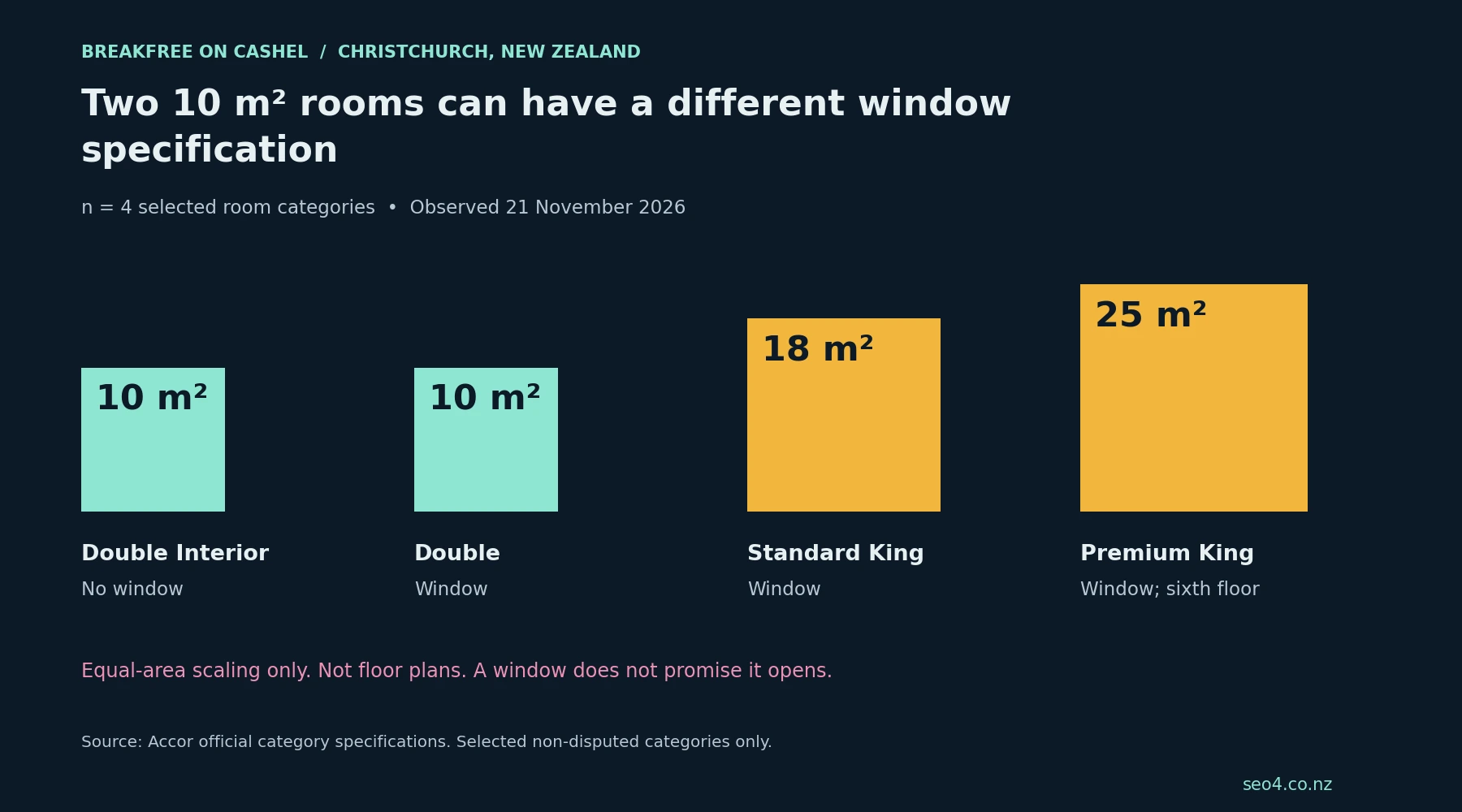
The room names deserve a careful read. Double Interior and Double both have an official area of 10 m²; the latter adds a window. Moving from one to the other therefore changes the window specification without increasing the stated floor area. Standard King offers 18 m², while Premium King offers 25 m² and is described as being on the sixth floor. Official room specifications.
| Selected category | Official area | Window description | Maximum occupancy |
|---|---|---|---|
| Double Interior | 10 m² | No window | 2 |
| Double | 10 m² | Window | 2 |
| Standard King | 18 m² | Window | 2 |
| Premium King | 25 m² | Window; sixth floor | 2 |
A window does not establish that it opens, provides privacy or faces an unobstructed view. Those details matter to someone sensitive to enclosed spaces or expecting fresh air. The official photographs on the hotel’s listing help explain the room formats, but they cannot establish the precise outlook of a future allocation.
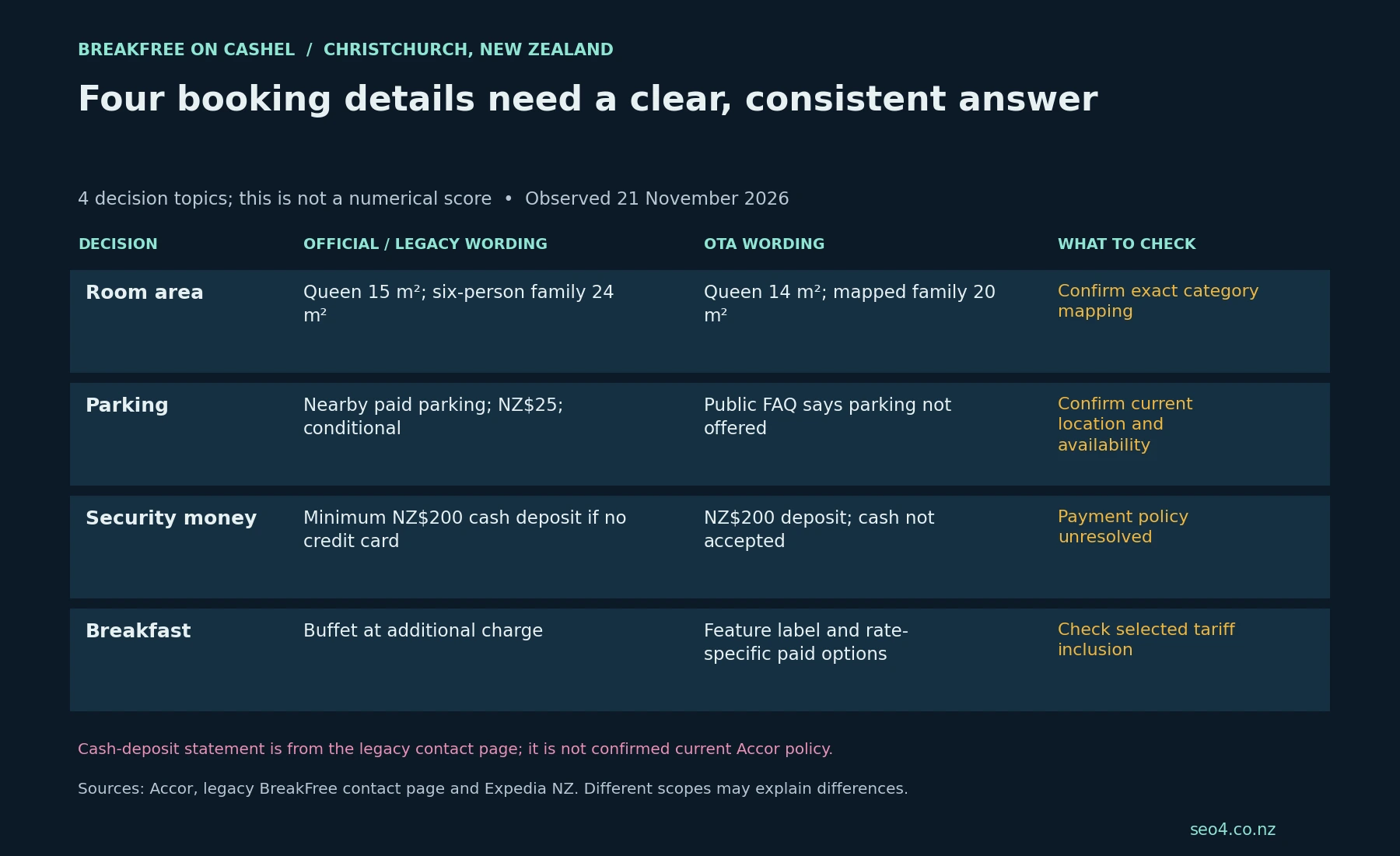
There are also Queen, Twin and family categories. Queen was listed at 15 m² by Accor and 14 m² by Expedia. The six-person family category was listed at 24 m² officially, versus 20 m² for the provisionally matched Expedia category. That family mapping follows capacity and bed configuration and needs confirmation. We kept both figures rather than picking whichever looks more attractive.
Dated room prices: what the upgrade changes
Our price checks used one room, two adults and one night, with selected non-refundable offers. Amounts below are NZD totals including displayed taxes and fees, observed on 21 November 2026. They are examples for specific stays, with availability and prices liable to change.
| Room category | 11–12 Dec 2026 | 20–21 Dec 2026 | 20–21 Jan 2027 |
|---|---|---|---|
| Double Interior | NZ$132 | NZ$90* | NZ$123 |
| Double | NZ$169 | NZ$145 | NZ$145 |
| Standard Queen | Not displayed | NZ$152 | Not displayed |
| Standard King | NZ$186 | NZ$165 | NZ$165 |
| Standard Twin | NZ$203 | NZ$166 | NZ$165 |
| Premium King | NZ$271 | NZ$207 | NZ$207 |
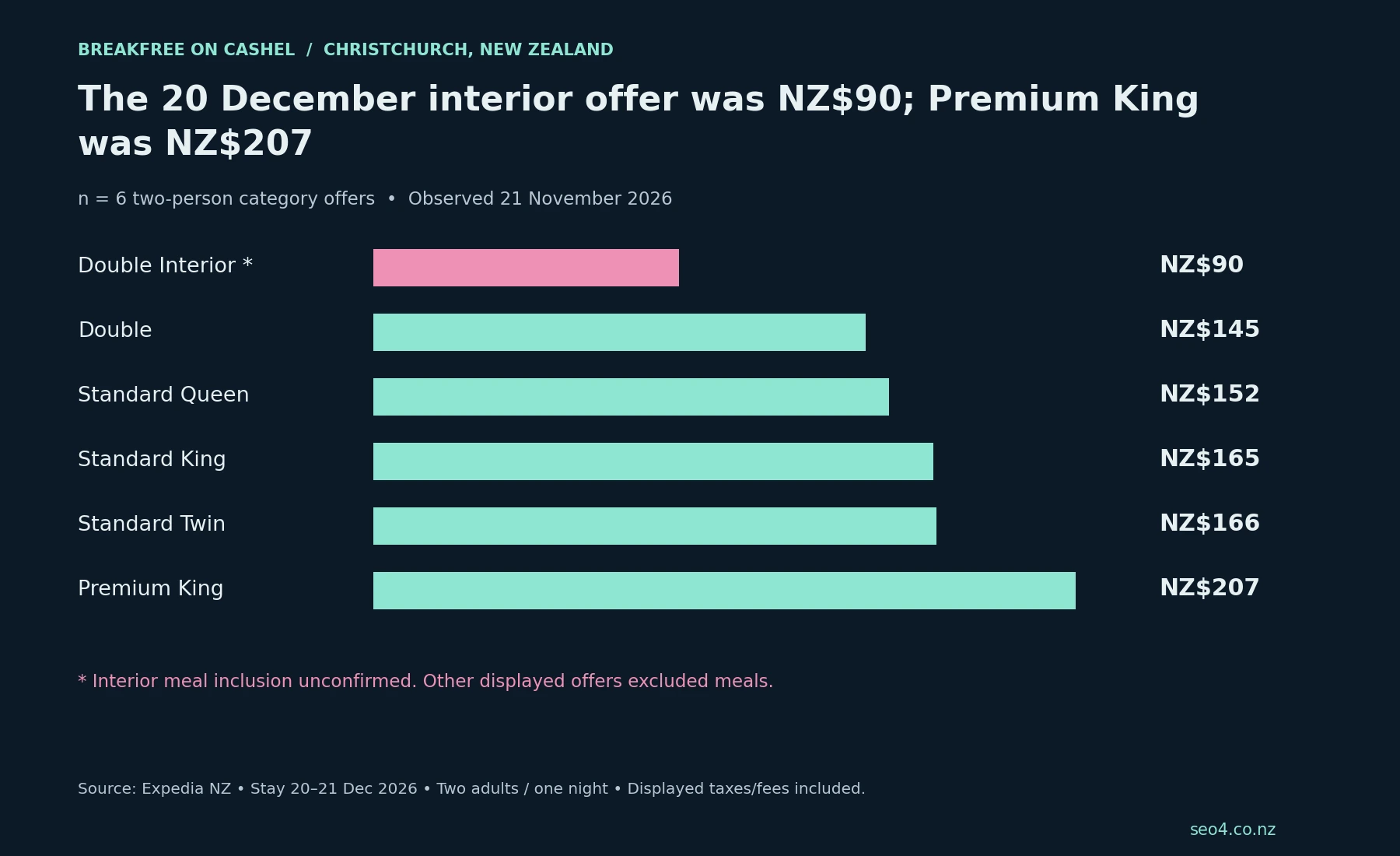
Meal inclusion for the NZ$90 Interior offer was unconfirmed. The other listed base offers excluded meals. “Not displayed” records the result of that search, without establishing that the category or hotel was sold out. Source: Expedia NZ property listing; the downloadable data retains the dated search URLs and quote identifiers.
On 20 December, choosing Double instead of Double Interior increased the displayed total by NZ$55 while retaining the same official 10 m² area. Premium King cost NZ$117 more than Interior. These are differences between category offers, with the Interior meal qualification still relevant; they do not demonstrate savings on identical accommodation.
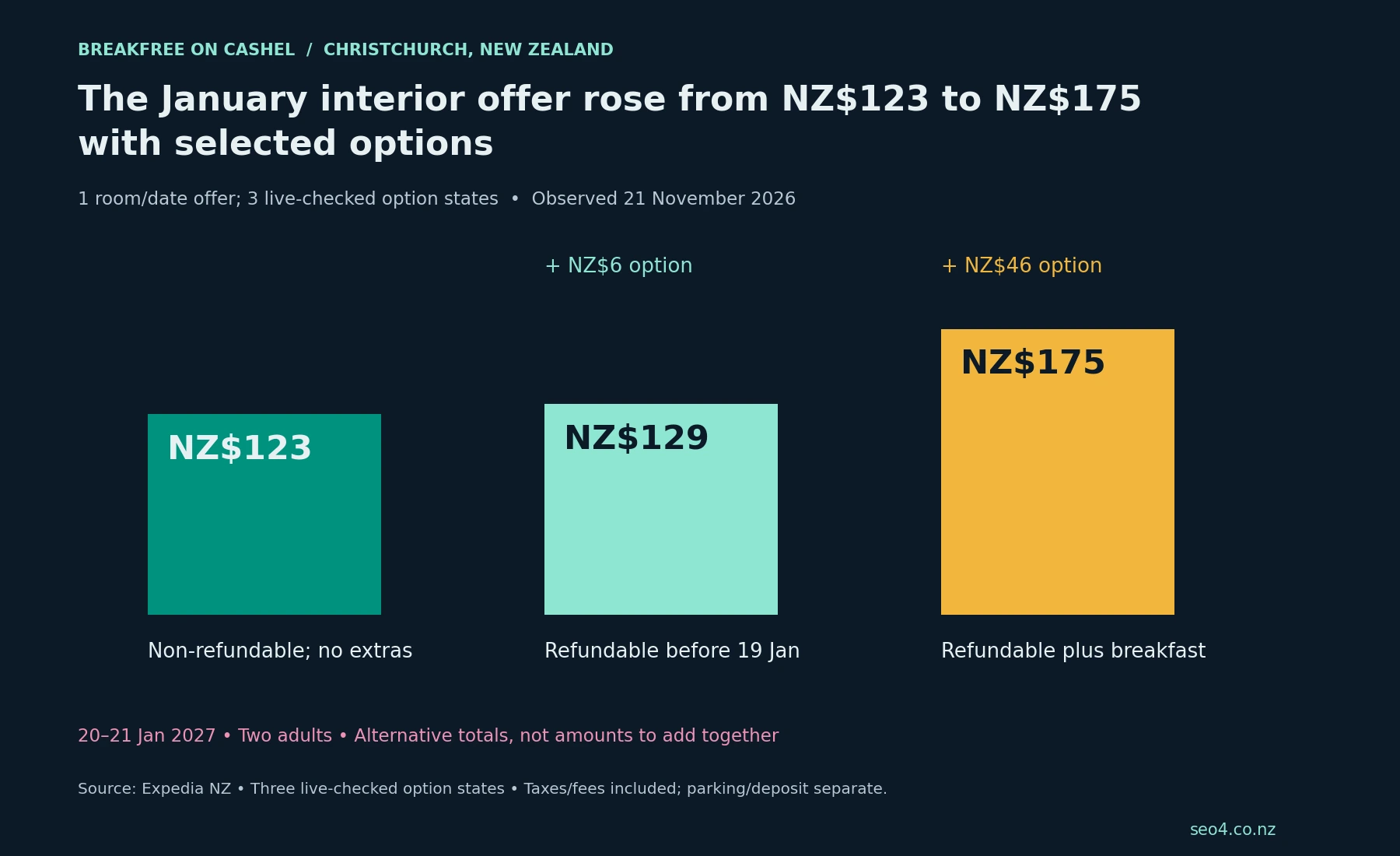
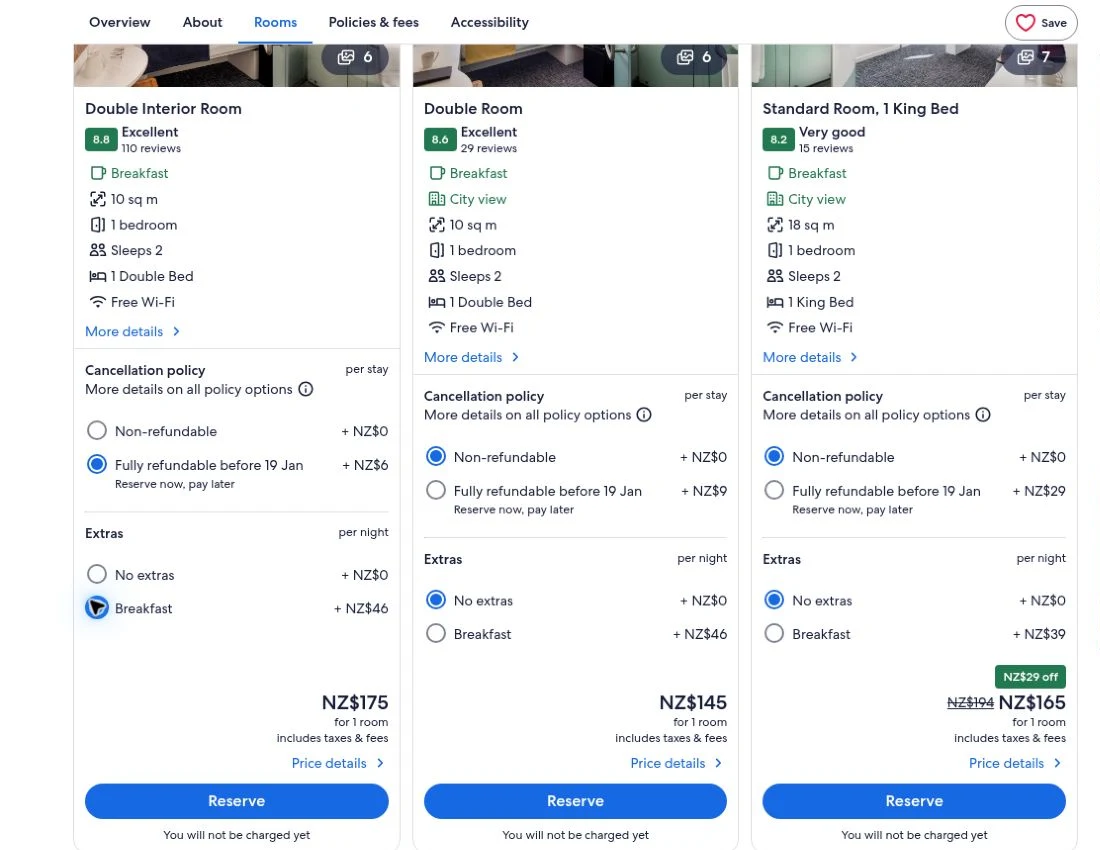
Terms can change the comparison again. For 20–21 January, Interior started at NZ$123. Selecting the recorded refundable option added NZ$6; adding the booking’s breakfast option added another NZ$46, bringing the displayed total to NZ$175. Those three states were checked in the booking interface. The breakfast addition applies to that selected two-adult booking, without establishing a universal per-person buffet price.
For the same January stay, Premium King started at NZ$207, with recorded supplements of NZ$37 for the refundable option and NZ$39 for breakfast. Our calculation gives NZ$283 with both selected. Its difference from Interior is consequently NZ$84 at the base selection, NZ$115 with both refundable, or NZ$108 with both refundable and breakfast. Matching the extras matters almost as much as reading the room name.
We recorded 22 offers across eight categories and three dates. Family-category offers were still searched for two adults, so they cannot be presented as prices for a full family. Three stay dates also provide no reliable basis for a seasonal forecast or a general weekend premium.
Compare two room offers from the research snapshot
The calculator below starts with the January Interior and Premium King offers. Choose the stay date, category and available supplements to compare the selected room totals. Every preset remains tied to our research date; the calculator does not fetch current availability.
A separate manual mode accepts your own quotations. Use matching dates, occupancy and duration, and enter any selected additional charges explicitly. Blank amounts remain unknown. The comparison reports B minus A, with qualifications when cancellation or meal terms differ. Optional NZ$25 parking is an illustrative, conditional addition shown separately. A universal arrival payment or complete trip budget is unavailable because the deposit and payment wording needs confirmation.
Room offer comparator
Compare selected room totals. Presets are dated research, without live availability. Manual entries are your own quotes.
Current deposit and payment terms need confirmation. No universal upfront or full-trip total is calculated. Parking is conditional. Room-price differences are not proven savings on identical products.
BreakFree on Cashel review: what the Google ratings tell us
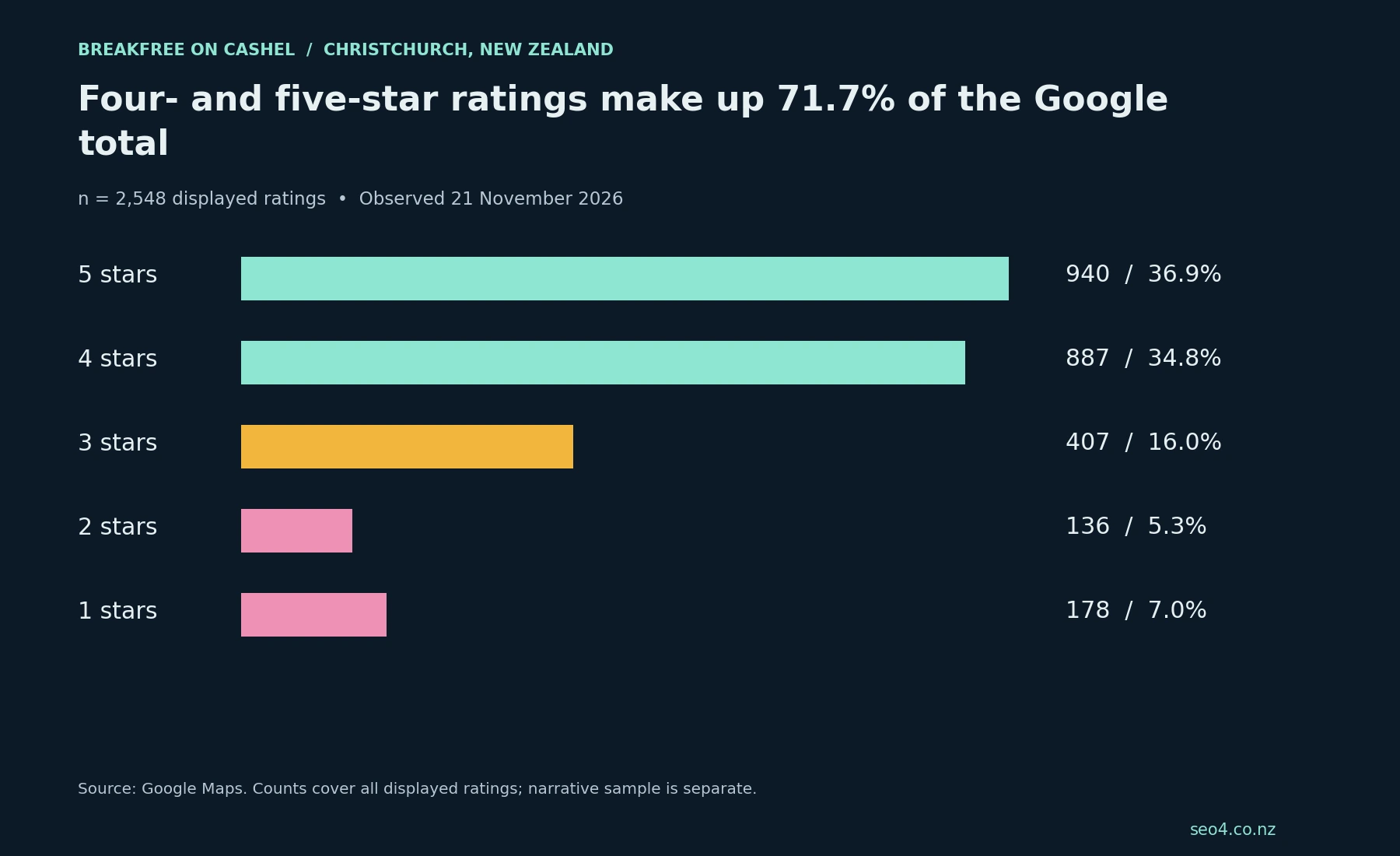
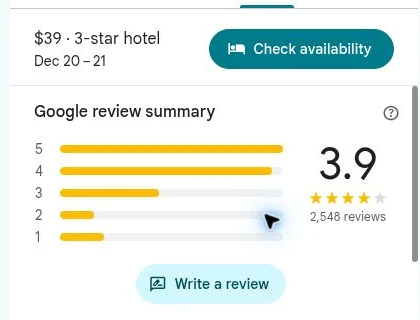
The Google Maps profile displayed 3.9 out of 5 from 2,548 ratings. Its histogram contained 940 five-star, 887 four-star, 407 three-star, 136 two-star and 178 one-star ratings. Four- and five-star ratings together represented 71.7% of the displayed total, by our calculation.
That distribution describes rating levels. It says nothing about the percentage of guests who disliked the bathroom, enjoyed breakfast or needed parking. It is also a guest score, separate from the hotel’s star classification: official/Google sources showed three hotel stars, while Expedia used a 3.5 property class.
Our narrative evidence is much smaller. We examined 15 distinct Google records: five exposed under Newest, five under Lowest rating and five under Most relevant. Fourteen contained some narrative; one contained rating or travel metadata only. Several excerpts were truncated. These are selected diagnostic records, with Google’s ordering influencing what was visible, rather than a random sample of 2,548 full reviews.
Owner replies were visible on 12 of those 15 records. That is a sample observation, not a property-wide response rate. Some of the newest records were only hours old, so an unanswered fresh review provides little basis for judging response discipline. We use the text to identify questions worth investigating, while keeping the full rating distribution separate.
Why small rooms work for some guests and disappoint others
Location is a favourable theme across the visible excerpts, including some accounts with a low overall rating. The practical trade-off is easy to understand: a central base can be attractive to someone spending most of the day elsewhere, while room space matters more to a guest settling in for a long evening.
Some sampled reviewers describe the accommodation as functional for a short stay. Others criticise limited space or the absence of a window. These experiences can coexist because expectations and room formats differ. Most excerpts do not identify an exact category, so we cannot assign individual complaints to Interior, Premium King or a particular floor.
The distinction becomes useful before booking. Check where luggage will sit, whether both travellers need space to move around the bed, and whether a desk or natural light is essential. A published room area and an accurately matched photograph are more helpful here than a broad promise of comfort. A bathroom described as tight is a separate consideration from the bedroom’s window specification.
Staff assistance and cleanliness receive favourable mentions in the sample. Other excerpts allege housekeeping or room-condition problems, with an additional account criticising temperature control and bedding. These are guest reports we have not independently verified. They support specific follow-up questions, without establishing the condition of every room or a property-wide equipment fault.
Parking accounts show a similar mixture: appreciation of nearby parking alongside surprise about availability, distance or access. One low-rating exchange describes an arrival problem while also praising a night staff member’s practical help. Another concerns booking confirmation and cancellation. Such disputes are useful signals for checking instructions and documentation; the visible excerpts cannot settle responsibility or quantify how often the underlying events occur.
Parking, breakfast and security money need clear answers
Parking information needs particular attention if you are arriving by car. Official material described nearby paid parking at NZ$25, subject to conditions. The legacy BreakFree contact page added that it could not be prebooked and could involve a walk of up to five minutes. Expedia’s public FAQ said parking was not offered. That may reflect a distinction between on-site hotel parking and a nearby arrangement, but the sources did not resolve it.
Before arrival, obtain the current location, access instructions, availability basis and payment arrangement. Someone arriving late or carrying substantial luggage needs an answer that explains what to do when the first option is unavailable.
Security money has a different uncertainty. The legacy contact page described a minimum NZ$200 cash deposit when a guest had no credit card. Expedia described a NZ$200 deposit per stay while also saying cash was not accepted. These statements should not be combined into a single current payment rule. Confirm accepted payment methods, the form of any security requirement and its applicable release conditions directly.
A security deposit or hold is distinct from accommodation expenditure. We therefore do not add NZ$200 to every room quote or promise when funds will become available again. We also leave an unconfirmed card-fee figure out of the calculator.
Breakfast needs the same attention to scope. A property feature labelled “Breakfast” does not identify what a particular tariff includes. Compare the meal wording of the selected rate, the people covered and the total booking charge. The observed NZ$39 and NZ$46 supplements belong to particular offers, rather than a common buffet tariff that can be applied to every booking.
Who should consider this hotel?
A traveller seeking a central Christchurch base and comfortable with the chosen compact format has a clear reason to consider BreakFree on Cashel. Interior may suit someone who explicitly accepts a windowless room; the windowed Double offers a different light specification at the same stated size. Standard King and Premium King provide larger published areas for guests who place more value on indoor space.
The decision deserves closer confirmation if an opening window, a particular outlook, guaranteed parking or specific accessibility features are essential. Families should obtain a quote for the actual number and ages of travellers and confirm the bed arrangement, rather than extrapolating our two-adult searches.
We did not establish a direct-booking price advantage or conduct a matched competitor-room comparison. Compare the hotel’s direct offer with any third-party offer using the same dates, category, cancellation conditions, meals and taxes. A lower initial figure can carry a materially different set of terms.
Website and local SEO: the details worth fixing
For the hotel’s marketing team, the strongest opportunity is to make the product easier to understand at selection. Room content, headings and images should consistently distinguish area, bed configuration and window status. Queen and family-category disagreements between channels are concrete reasons to maintain a verified room specification shared across the official listing and distribution partners. We did not establish whether dedicated category URLs exist, so this is a content-consistency recommendation rather than a verdict on missing pages.
Photography can reinforce that clarity. Label the actual category beside each image, retain an honest perspective and make the no-window distinction visible before the booking decision. Descriptive image alternatives and sensible image delivery belong in a subsequent implementation check; this audit did not measure the main site’s image performance or inspect every image alternative.
Public name, address and phone information aligned across the inspected official and Google sources. The next local-search task is practical arrival consistency. A guest moving from Maps to the website and then to a booking platform should receive compatible parking instructions. Room format, parking, deposit and breakfast questions also offer a useful basis for supporting content around branded review and booking intent. We have not measured keyword volumes or local rankings.
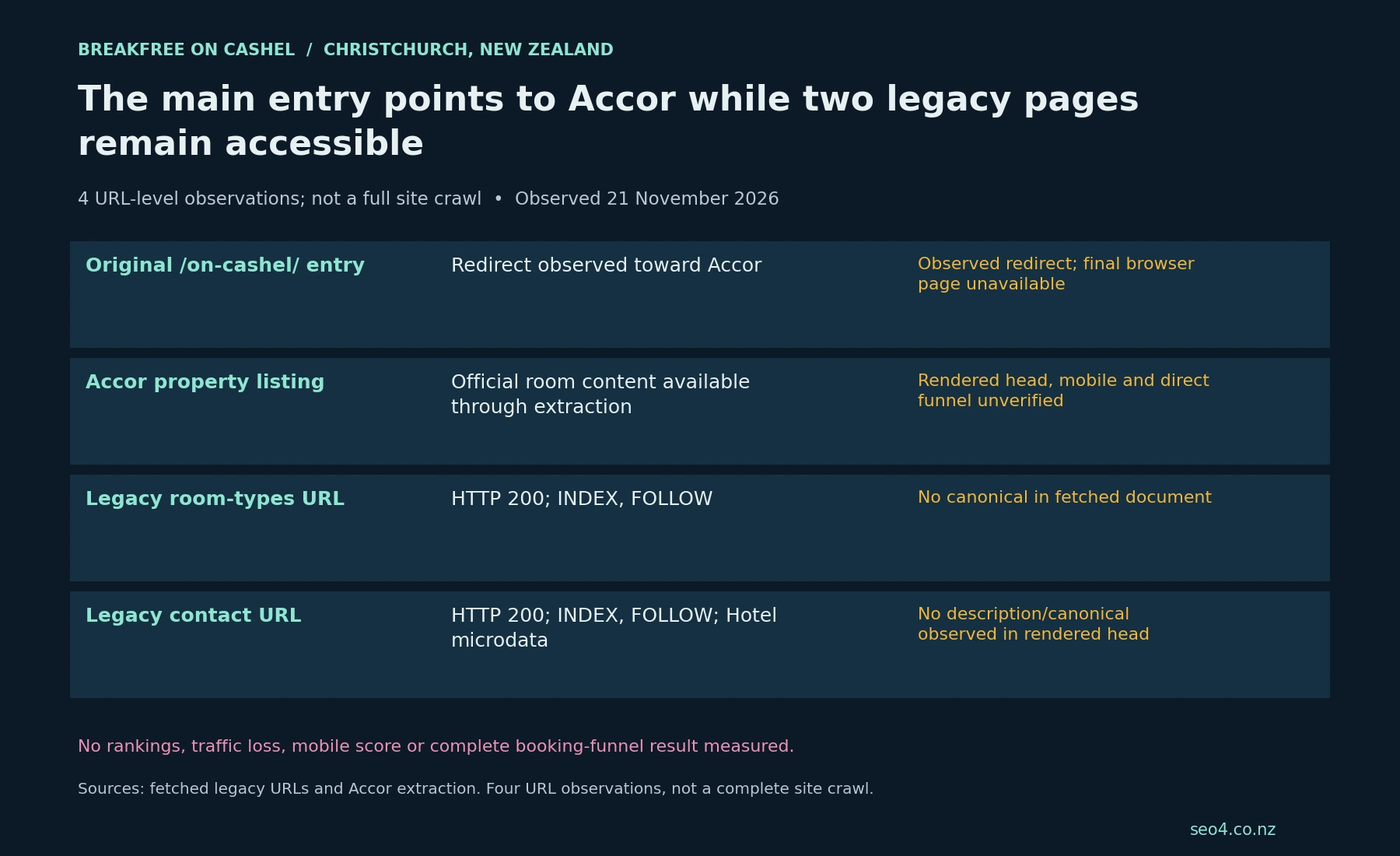
The technical evidence concerns specific entry points. The original BreakFree hotel URL redirected towards Accor, while legacy contact and room-types pages remained accessible under a /divested/ path. Both fetched legacy pages returned HTTP 200 with an index/follow directive. That establishes accessible pages and crawler instructions, without proving how Google has indexed them or identifying a change of ownership from the path name.
No canonical was observed in the fetched legacy documents; the rendered contact-page head also lacked an observed meta description. These are scoped observations about those URLs. Review their purpose, content overlap and migration intent before selecting redirects, consolidation or metadata changes. We have no Search Console evidence of Google’s selected canonical, no measured ranking loss and no basis for declaring a penalty.
Structured data was already present on the rendered legacy contact page as Hotel and AggregateRating microdata. An absence of JSON-LD would not make that markup disappear. The legacy rating widget was labelled Tripadvisor, so it should not be described as the Google score. Validate the intended entity and the existing implementation before adding markup; this research does not establish rich-result eligibility or a ranking benefit.
Main-site mobile usability, speed, Core Web Vitals and the direct-booking journey remain unverified. Our booking observations covered public Expedia room selection and option changes, without making a reservation or completing payment. Those limits rule out a reliable performance score, a direct conversion verdict or a claim that ordinary customers face a broken booking site. Competitor opportunities likewise remain hypotheses until comparable rooms and booking paths are examined.
A practical order for the improvements
| Priority | Evidence and guest consequence | Recommended action | Limit |
|---|---|---|---|
| First | Room areas/window descriptions can change the purchase decision | Verify one category specification and distribute it across channels | Confirm the Queen/family mapping first |
| First | Parking and deposit wording differ between sources | Publish current arrival/payment instructions and align channel wording | Current operational policy needs confirmation |
| Next | Original entry redirects while legacy pages remain accessible | Review each legacy URL’s role and choose an intentional migration treatment | No indexation or ranking loss demonstrated |
| Verify | Main-site mobile, speed and direct funnel were not measured | Test representative devices, page loading and booking steps | Assign no score until measured |
These are editorial priorities based on guest decisions, without a predicted revenue uplift. After a change, the team could track room-category questions, arrival enquiries and booking-path completion using its own systems. Those would be future measurements, with baselines and consent requirements established by the operator.
For a broader owner-facing discussion, our Dunedin motel direct-booking guide addresses the search-to-booking journey in a different city and accommodation segment. Its purpose is complementary to this branded Christchurch review.
The quickest useful copy change would be a concise room-selection summary showing the category, area, window statement, selected meal plan and cancellation conditions together. Follow it with current arrival and payment instructions in the confirmation message. This puts the practical answer at the moment the guest needs it, while the broader technical review addresses the remaining evidence gaps.
How this review was researched
The research snapshot is 21 November 2026. We compared Accor’s official descriptions, accessible legacy BreakFree pages, the public Google profile and three dated Expedia NZ searches. The price dataset contains 22 offers for one room, two adults and one night; selected supplements and one January option sequence were also recorded.
The rating histogram covers 2,548 displayed ratings. Narrative analysis covers 15 selected records with incomplete-text limitations, using paraphrases rather than republishing full reviews. We made no personal stay, room inspection or staff interview and had no private analytics. We kept the source records, exact search setups, all eight room categories and the 18 scoped audit findings on file.
Frequently asked questions
Do all rooms have windows?
No. The official Double Interior description specifies no window. Double, Standard King and Premium King have window descriptions. Confirm the exact category and ask separately whether an opening window or particular outlook is available.
How small is Double Interior?
The official area is 10 m², matching Expedia’s category figure. Windowed Double is also listed at 10 m². Published areas help compare formats but do not describe the usable space around every item of furniture.
How much does a room cost?
Our Interior examples were NZ$132, NZ$90 and NZ$123 for three specified one-night stays, with two adults. They are dated quotes observed on 21 November 2026, with terms described above. Check a fresh offer for your own dates.
Is Premium King worth the upgrade?
Its official 25 m² area and window differentiate it from 10 m² Interior. The base price gap was NZ$84 for our January example. Its value depends on how much time you expect to spend in the room and the terms selected.
Is breakfast included?
It depends on the tariff. The recorded base offers generally excluded meals; inclusion for the NZ$90 Interior offer remained unconfirmed. Check the selected booking rather than relying on a property feature label.
Is there hotel parking?
Official and legacy material described conditional nearby paid parking, while Expedia’s FAQ said parking was not offered. Confirm the present arrangement, location and access instructions directly, particularly for a late arrival.
Will I need a NZ$200 deposit?
The inspected sources disagreed about payment methods and the scope of the security requirement. Confirm the current rule for your booking. We cannot establish a universal arrival amount or fund-release timetable from those statements.
What are the check-in and check-out times?
The inspected official/contact sources listed check-in from 2 pm and check-out by 10 am. Confirm any requested exception with the hotel; this research did not establish early-arrival or late-departure availability or charges.
What do Google reviews say?
The profile showed 3.9/5 from 2,548 ratings. Our small diagnostic text sample included location and staff praise alongside room-space and arrival concerns. It cannot establish how common a particular complaint is among guests.
Is booking direct cheaper?
We did not establish a direct-price advantage. Compare current offers for the same category, dates, occupancy, meals and cancellation terms, with displayed taxes and fees included, before deciding which offer is better for your stay.
Run a hotel or motel in Chch?
We check what guests see before they book: your Google profile, your room pages, your reviews and the listings ranked above you. You get a short list of fixes in the order we would make them.