
SEO Auckland: be found where your customers actually look
An evidence-led guide to local SEO for Auckland businesses. Understand the market, choose the right channels and invest where discovery turns into enquiries.

01 / The market
What Auckland’s economy tells us about local search
Auckland Council’s 2025 Economic Monitor estimates a regional population of about 1.8 million in 2024 and approximately 227,000 businesses. The region produced 38% of New Zealand’s GDP in 2024. Those are regional figures: they should not be confused with the urban-area population or presented as a tally of websites competing for a search phrase.
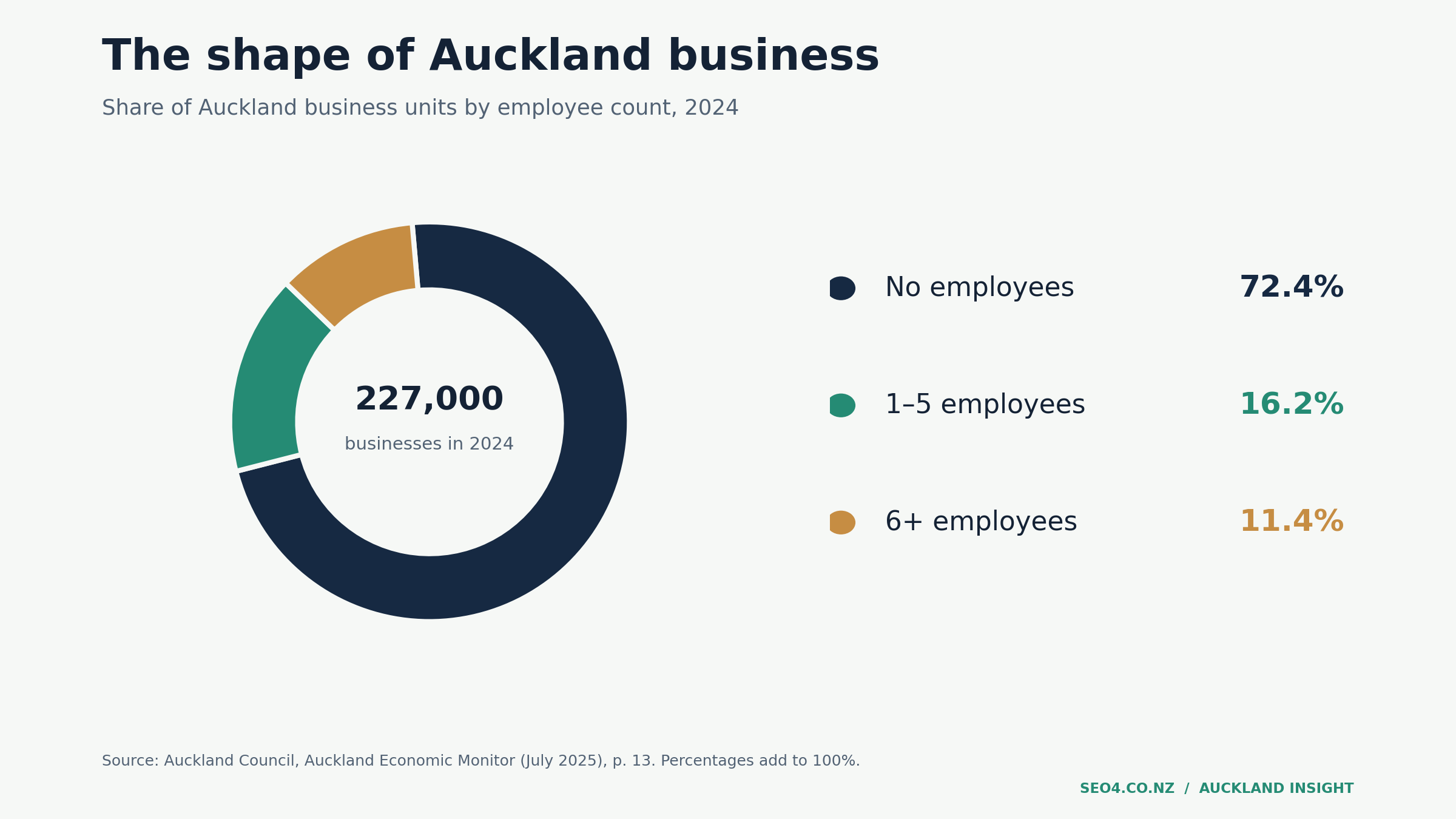
The same report finds that 72.4% of businesses had no employees and a further 16.2% had one to five employees in 2024. For a small operator, online visibility is often a question of where to spend scarce time and money. Google Business Profile, helpful service pages, an accurate website and paid search can each play a part; the order depends on the market.
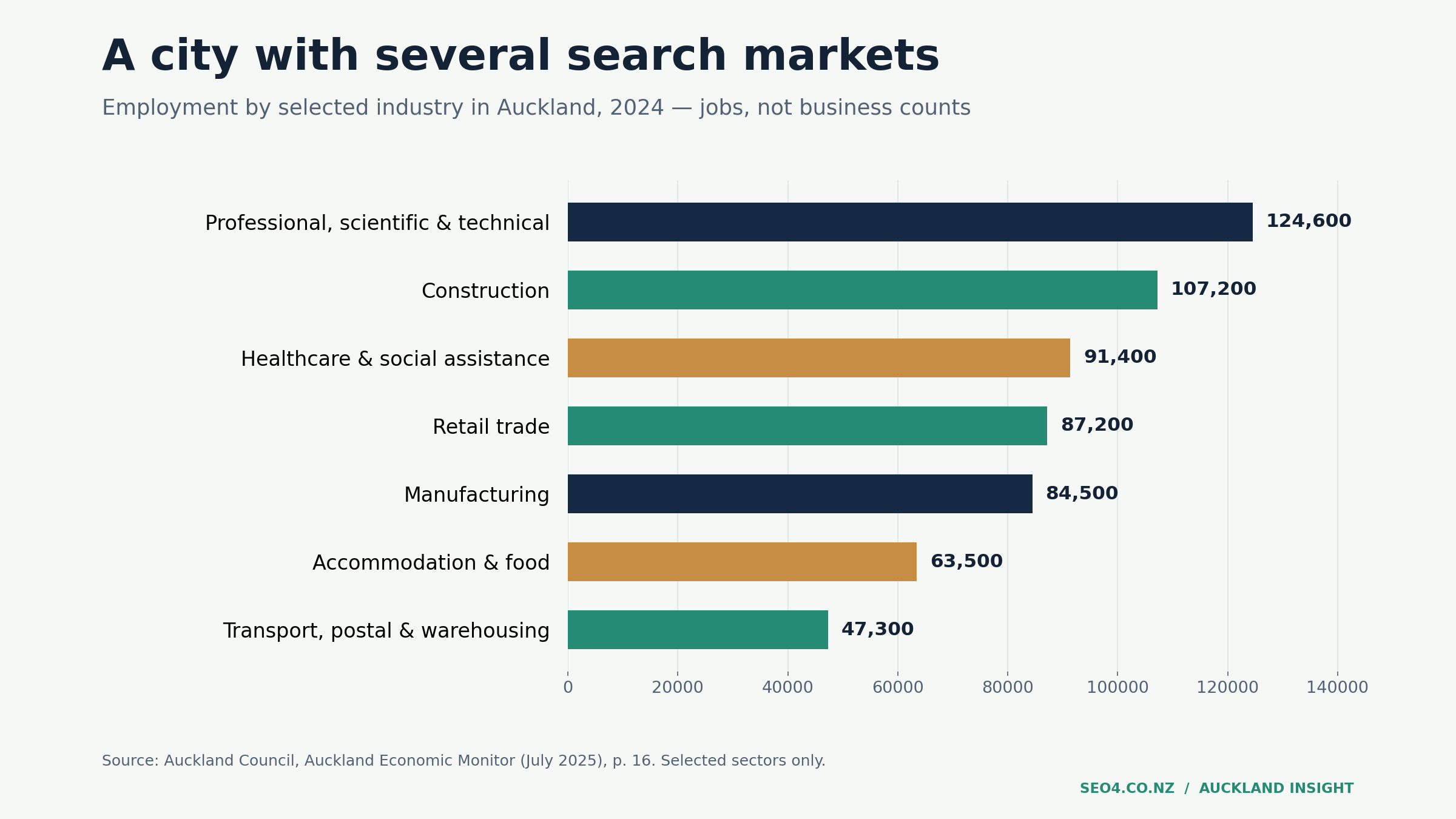
Sector employment helps explain the scale and variety of possible customers, although employment does not measure search competition. In 2024 the report recorded 124,600 jobs in professional, scientific and technical services; 107,200 in construction; 91,400 in health care and social assistance; 87,200 in retail; 84,500 in manufacturing; 63,500 in accommodation and food; and 47,300 in transport, postal and warehousing. A useful SEO plan then tests an individual niche with search demand and actual search results, rather than assuming every large sector is easy or lucrative online.
If you want help assessing that opportunity, see our SEO services across New Zealand and request a discussion about your Auckland market. We can start with the services, areas and enquiries that matter to your business, then agree on a scope that fits the evidence.
02 / Search demand
SEO Auckland search terms: what the available numbers do, and do not, say
The Google Ads Keyword Planner ranges supplied for this project cover Google searches across New Zealand for September 2025 to August 2026. They are rounded monthly bands for searches containing an Auckland place name, not a count of people physically searching from Auckland. Similar queries may overlap through close variants; adding the rows together would misrepresent total demand.
| Search phrase | Average monthly range | How it informs the page |
|---|---|---|
| seo auckland | 1,000–10,000 | Broad agency and service discovery; high-intent but broad intent. |
| seo services auckland | 100–1,000 | People comparing a specific service. |
| auckland seo agency | 100–1,000 | Provider comparison; useful for proof and process details. |
| local seo auckland | 10–100 | More specific local search intent; smaller measured band. |
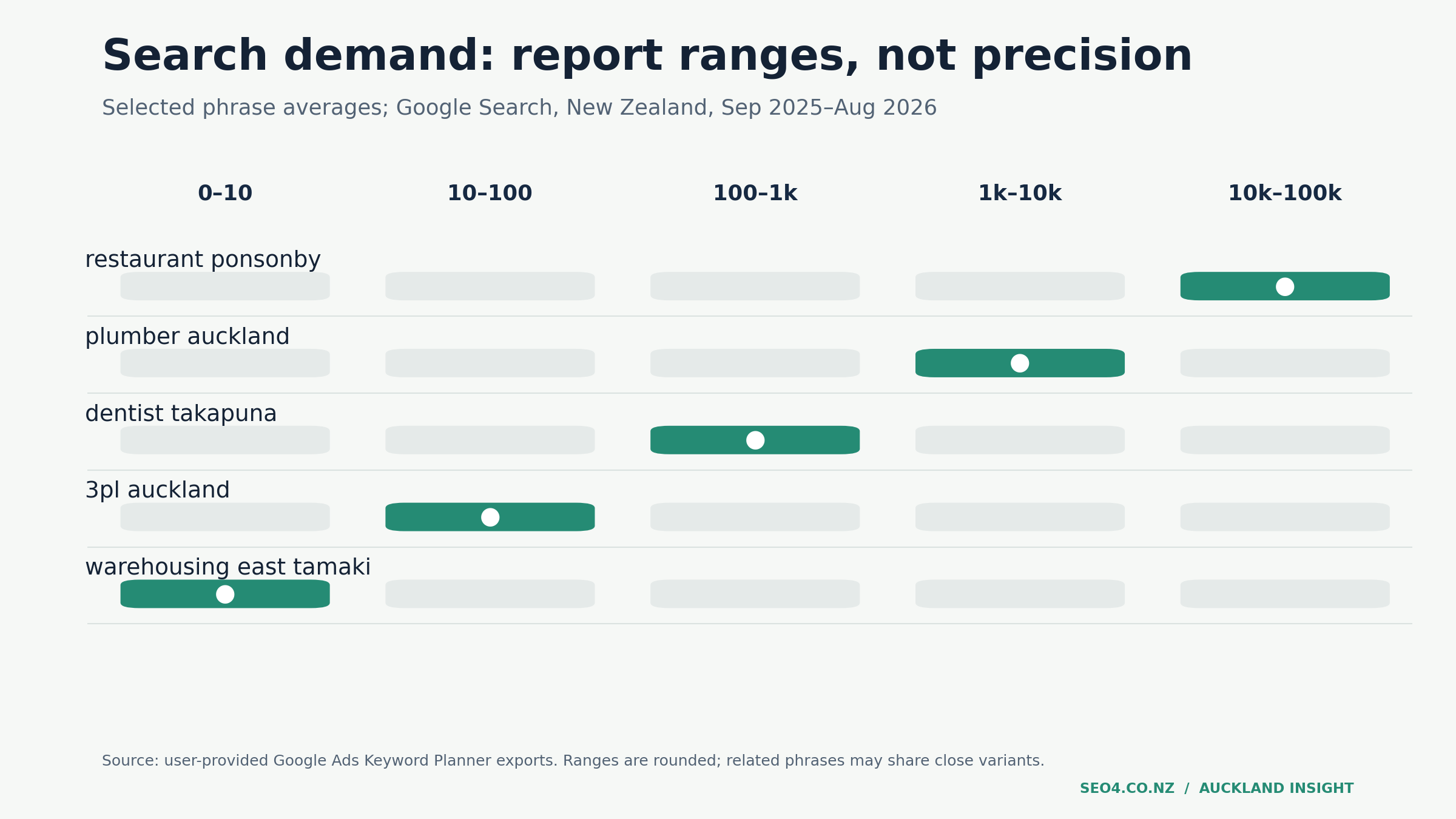
Illustrative niche terms from the same supplied NZ-targeted dataset include “plumber auckland” at 1,000–10,000, and “emergency plumber auckland”, “electrician auckland”, “roof repair auckland”, “accountant auckland”, “lawyer auckland” and “property management auckland” each at 100–1,000 average monthly searches. “Restaurant ponsonby” is in a 10,000–100,000 band. The breadth of that last band makes it a signal to investigate, not a forecast for one restaurant. Separately supplied screenshots show “dentist takapuna” at 100–1,000, “3pl auckland” at 10–100 and “warehousing east tamaki” at 0–10. Lower volume does not automatically mean lower commercial value: a qualified B2B contract can justify work that a low-margin walk-in purchase cannot.
Do not read the Planner’s “competition” column as organic SEO difficulty. It reflects competition among advertisers for ads. To estimate organic opportunity, inspect actual local results on relevant devices and locations, noting the map pack, directories, service pages, reviews and the firms repeatedly appearing for the queries that drive sales.
03 / Place and intent
One city, several distinct buying journeys
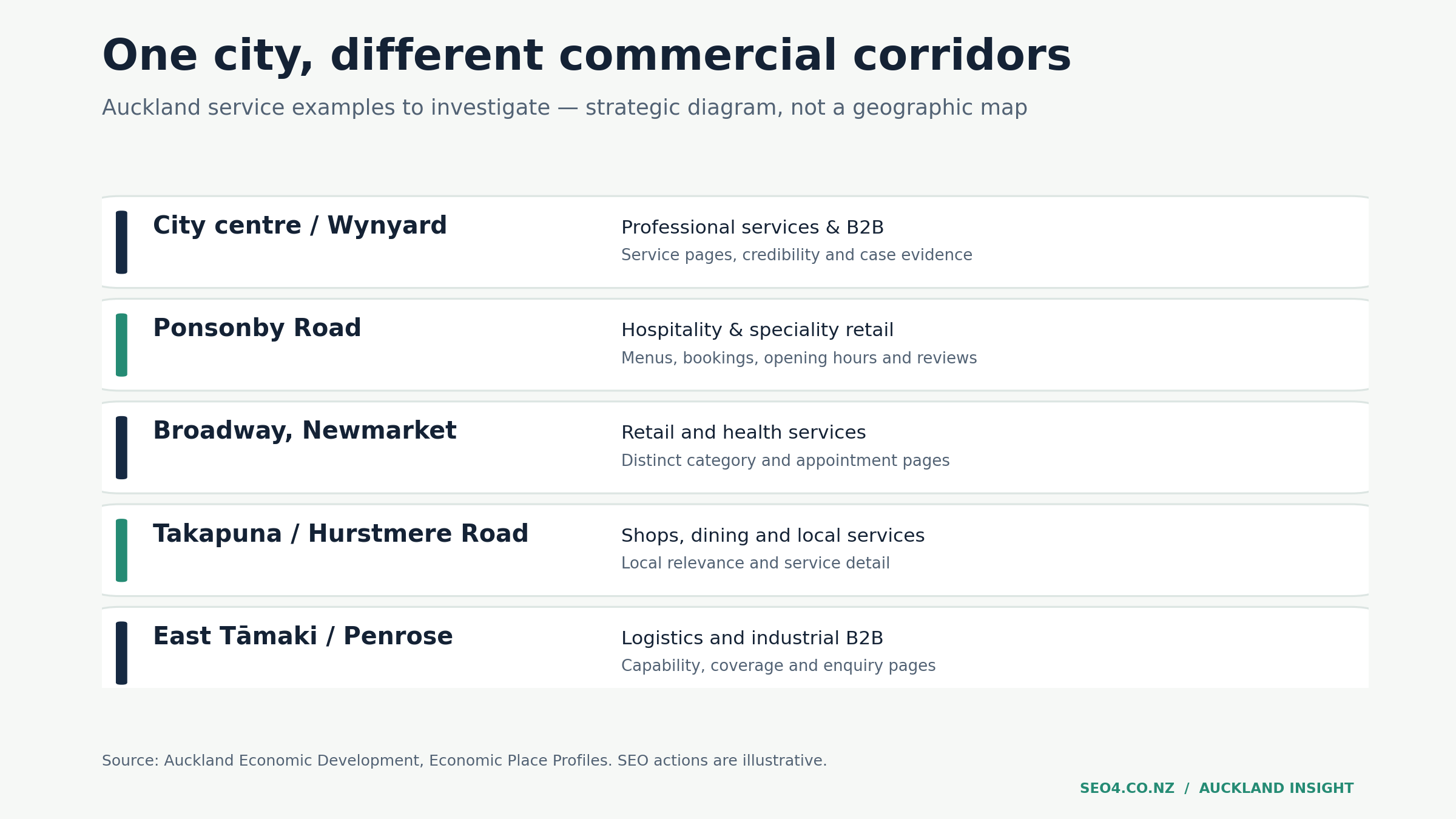
Our Auckland SEO research treats the city as a set of connected catchments rather than one keyword. A city-centre professional-services firm may need evidence of expertise and a strong organic page; an after-hours service needs a readily available phone number and coverage details; a retailer needs accurate opening hours, inventory cues and directions. The Auckland Economic Development place profiles support looking at precincts as distinct economic places. The corridor examples below are editorial planning examples, not measured counts of competitors on those streets.
| Catchment and recognisable corridor | Typical search need | Useful page and profile evidence |
|---|---|---|
| City Centre, Queen Street and Wynyard Quarter | Accounting, legal, consulting or B2B enquiries | Service scope, credentials, sector experience and a clear contact route. |
| Ponsonby Road and nearby Grey Lynn | Dining, hospitality and appointment-led services | Current hours, menus or services, authentic photos and booking details. |
| Newmarket around Broadway | Retail and health appointments | Location access, products or treatments, pricing context and availability. |
| Takapuna around Hurstmere Road and the North Shore | Dental, allied health and specialist appointments | Practitioner information, treatment pages, address accuracy and patient questions. |
| East Tāmaki, Penrose, Wiri and Great South Road | Industrial supply, warehousing, 3PL and trade services | Capabilities, service geography, delivery constraints and request-for-quote details. |
Names of suburbs and roads only help when they describe real coverage. A contractor who genuinely serves Mt Roskill, Māngere and Onehunga can explain travel times, job types and booking arrangements in a useful service-area section. Repeating the same paragraph with different suburb names creates weak pages and can run into Google’s doorway-page guidance. A physical address must refer to a real place where that business is eligible to present itself; do not manufacture an Auckland office or profile for ranking purposes.
04 / Investment decision
When Google Maps is enough, and when SEO services in Auckland earn their keep
Google describes local ranking in terms of relevance, distance and prominence. Accurate profile information, service categories, hours, photos and reviews can help people choose a business. The map result is not a substitute for an explanatory website when the decision involves several services, a wider catchment or serious due diligence. Organic pages can answer questions a profile cannot, while paid ads can cover urgent demand as SEO develops.
| Approach | Advantages | Limits / costs | Best initial fit |
|---|---|---|---|
| Google Business Profile | Shows hours, calls, directions, reviews and photos; useful to establish local presence. | Proximity influences visibility; profile space is limited; results can change by location. | Small service area, few credible rivals, straightforward purchase. |
| Local organic SEO | Explains services and proof in depth; can reach multiple relevant searches over time. | Needs technical upkeep, original content and patience; no ranking guarantee. | Meaningful competition, complex services, multiple genuine catchments. |
| Google Ads | Can test demand and message promptly; budgets and queries are adjustable. | Clicks cost money, and paid traffic stops when ads stop; monitoring is essential. | Immediate enquiries, launch testing or seasonal demand. |
| Integrated approach | Combines profile, site, tracking and selective ads around business goals. | Requires coordinated measurement and a sensible budget. | Competitive categories with a valuable enquiry or repeat customer. |
Imagine there are only two local panel beaters serving a tightly defined area, both easy to find, and customers mainly call the nearest shop. Completing a Google Business Profile, fixing contact details and improving an existing service page may be sufficient. This is a decision example, not a verified count of Auckland panel beaters. Additional SEO work should be justified by missed enquiries, a target for broader suburbs or more specialised repairs.
Now imagine a separate search where you can see about twelve credible businesses for the same service and your relevant page repeatedly appears on page two of organic results. That is a prompt to inspect which pages answer the query better, how the map pack looks and whether competitors show stronger proof. “Twelve” is a hypothetical diagnostic, not a universal SEO threshold; Google results are personalised by location and change over time. A newly established firm may also need a strong foundational site and profile before it has any rankings to compare.

05 / Sector playbook
Where Auckland businesses can use local SEO well
Trades and urgent home services
For plumbers, electricians, roofers and similar businesses, intent varies sharply. An emergency leak query needs a fast route to a phone number, hours, areas actually served and clear call-out conditions; a planned re-roofing job calls for materials, project examples, process and a quote path. “Plumber auckland” and “emergency plumber auckland” sit in different Planner bands in the supplied data. They should be assessed separately and matched to pages that answer different questions. A mobile trade business serving Henderson and New Lynn should explain coverage honestly rather than claim a base in every suburb.
Health, dental and appointment-led care
A Takapuna dentist can be discovered for a local appointment query, but patients may then compare treatment details, practitioner qualifications, accessibility, costs and booking arrangements. The supplied “dentist takapuna” range of 100–1,000 NZ-wide monthly searches indicates an identifiable local-intent topic; it does not tell us the number of appointments available to one practice. Health content needs careful review by the provider, accuracy about regulated services and no invented patient outcomes.

Professional services and property
Accountants, lawyers and property managers often have higher-consideration enquiries. Broad phrases such as “lawyer auckland” can be useful as market signals, but a firm should also answer the more precise need: commercial leases, tax for growing companies or management for a particular property type. A City Centre accountant might publish pages explaining who they help, their process and where to meet or work remotely. A property manager working across suburbs can distinguish landlord questions from tenant support and provide documented service areas. Search visibility matters only if the resulting enquiries fit the firm’s capacity and expertise.
Hospitality and retail precincts
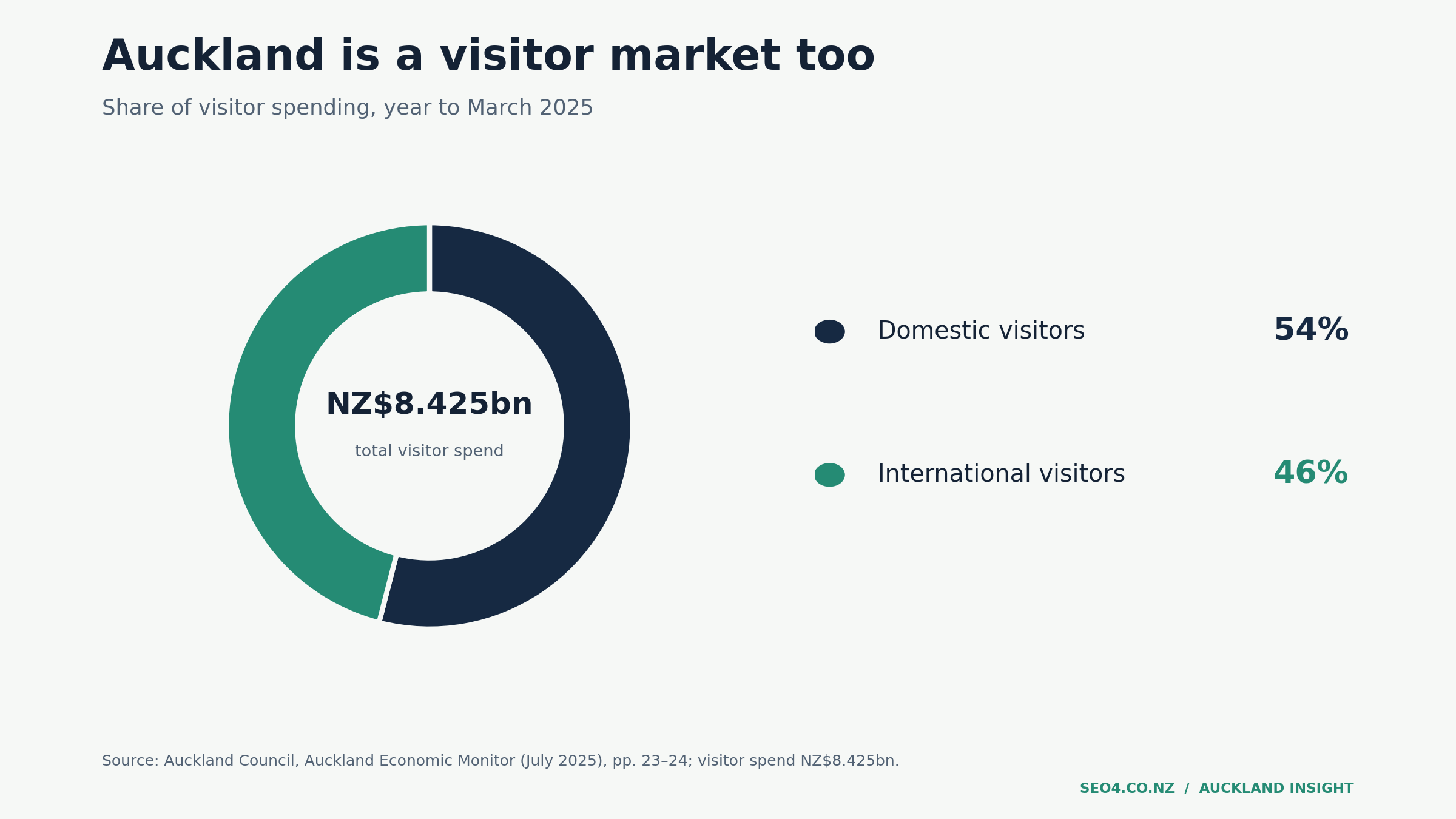
A restaurant on Ponsonby Road can improve the journey from a “restaurant ponsonby” search to an actual table with a current menu, dietary information, authentic photography and easy booking. Newmarket retailers near Broadway need accurate hours, in-store availability and useful category pages. The visitor economy adds another audience: Auckland’s tourism spend totalled NZ$8.425 billion in the year to March 2025, with approximately 54% domestic and 46% international visitor spending, according to the Economic Monitor. These are spend shares, not visitor shares or a forecast of search traffic. Businesses welcoming visitors can make opening times, accessibility and directions especially clear.
Industrial supply and logistics
An East Tāmaki 3PL provider does not need millions of searches if a handful of suitable contracts have substantial value. The supplied data places “3pl auckland” at 10–100 and “warehousing east tamaki” at 0–10 average NZ-wide monthly searches. Those narrow bands are a reason to check related vocabulary and actual sales conversations, not a reason to abandon the category. Pages should make capability tangible: storage types, integration possibilities, order volumes, delivery territory, service-level process and an enquiry route. If a facility is in East Tāmaki, its address and service reach should be stated accurately; Penrose and Wiri can feature when there is a genuine operational connection.

Search demand suggests strong potential in trades, hospitality, health and professional services, while higher-value niche contracts may justify work in logistics. It does not establish which niche has the hardest organic results. We would verify a shortlist by checking live results, the map pack, the quality and number of relevant providers, and the value of a qualified enquiry. No unmeasured SERP competition score is implied here.
06 / Delivery
A practical Auckland SEO plan, from baseline to enquiry
- Define the buying geography. List real premises, mobile coverage, travel limits and priority catchments. Separate a suburb you serve from an address you actually occupy.
- Map demand to service value. Start with profitable jobs and customer questions. Use Planner bands as directional evidence, then inspect search results for each intent.
- Fix the foundations. Check crawlability, page titles, mobile usability, internal links, contact information and consistent business details. Make the Google Business Profile complete and accurate where eligible.
- Build useful evidence. Create distinct service pages where needs differ; show the actual process, specifications, team credentials and authentic imagery that a prospect needs to choose.
- Measure business outcomes. Establish call, form and booking tracking with sensible privacy controls. Compare qualified enquiries, lead quality and conversion against a baseline, not rankings alone.
- Review and adjust. Recheck results by geography, update services and hours, refine pages from real questions and change investment when evidence warrants it.
For example, an emergency plumber might begin with one well-structured emergency-service page, an accurate eligible profile and call tracking, then test paid search while organic discovery develops. A 3PL firm might prioritise detailed capabilities and a sales-qualified enquiry form. An appointment business might give practitioner pages, treatment clarity and booking friction the most attention. This is why one generic Auckland SEO package is rarely the right starting brief.
AI-generated answers are changing the appearance of some Google results, but Google’s own guidance on AI features says the usual Search fundamentals apply and no special file or markup is required to appear in AI features. Keep verifiable, useful information on accessible pages and monitor how discovery shifts. Do not buy a promise of a guaranteed placement in an AI answer, local map pack or organic top position.
07 / Common questions
Questions Auckland business owners ask
Is a Google Business Profile enough for my business?
Sometimes. If local competition is limited and people already find and choose you easily, profile accuracy and a clear basic website may be enough. Consider broader SEO when relevant enquiries go to competing sites, customers compare complex services or you have several genuine service catchments.
How long does Auckland SEO take?
There is no reliable single timetable. Fixing contact details can help users immediately; improvements to crawling, content and organic visibility can take longer and depend on competition and the starting condition of your site. Set a baseline, agree on milestones and judge qualified enquiries over time.
Do I need a separate page for every Auckland suburb?
No. A page is useful when it answers a genuinely distinct local need with real coverage, examples and practical details. Replacing only suburb names across otherwise identical pages creates a poor user experience and may breach Google’s doorway-page policy.
Can my firm rank if we have no Auckland office?
Organic pages can describe genuine Auckland service availability, but claims about premises and eligibility for a Google Business Profile must be truthful and follow Google’s rules. A fictitious address is not a local SEO tactic.
Does a high search-volume range guarantee leads?
No. Google Ads Keyword Planner bands are approximate, can cover close variants and do not predict organic clicks, conversions or suitable customers. Search intent, your competitive offer and the value of each enquiry matter more than a broad range on its own.
Make a better local search decision
Find out where your Auckland customers lose sight of you
Tell us what you sell, where you genuinely work and what a worthwhile enquiry looks like. SEO4 can assess your current visibility and discuss an appropriate mix of Google Business Profile work, useful service pages, technical SEO and paid search.
Discuss SEO for your Auckland business →