
How much does it cost to build an app for a small business in New Zealand? The honest answer depends on the job it must do. Public NZ provider guides put a basic mobile MVP anywhere from NZ$5,000–$15,000 to NZ$15,000–$30,000. Those are the providers’ published estimates, not a universal market rate or a quote from us. A focused internal web tool, a prototype and a full customer-facing app are different purchases. The first step in estimating the cost for developing an app is deciding which of those you actually need.
For a small firm, the useful question is often smaller than “Can I afford an app?” It is “Which repeated task is costing us time or losing information?” A booking system, a reorder form and a stock synchronisation platform should not receive the same brief. We develop custom applications for New Zealand businesses, and a good discussion starts with one real workflow and the people who use it. That makes the cost for developing an app something you can investigate rather than guess.
What drives the cost for developing an app?
The largest difference is usually scope. A screen that collects an order is one task; giving customers accounts, charging cards, synchronising inventory, sending notifications and working offline across devices introduces separate design, security, testing and support work. Ask a developer to show each dependency in the estimate. A cheaper initial release should still handle data responsibly, work on the devices your staff use and have a clear plan for backups and ownership.
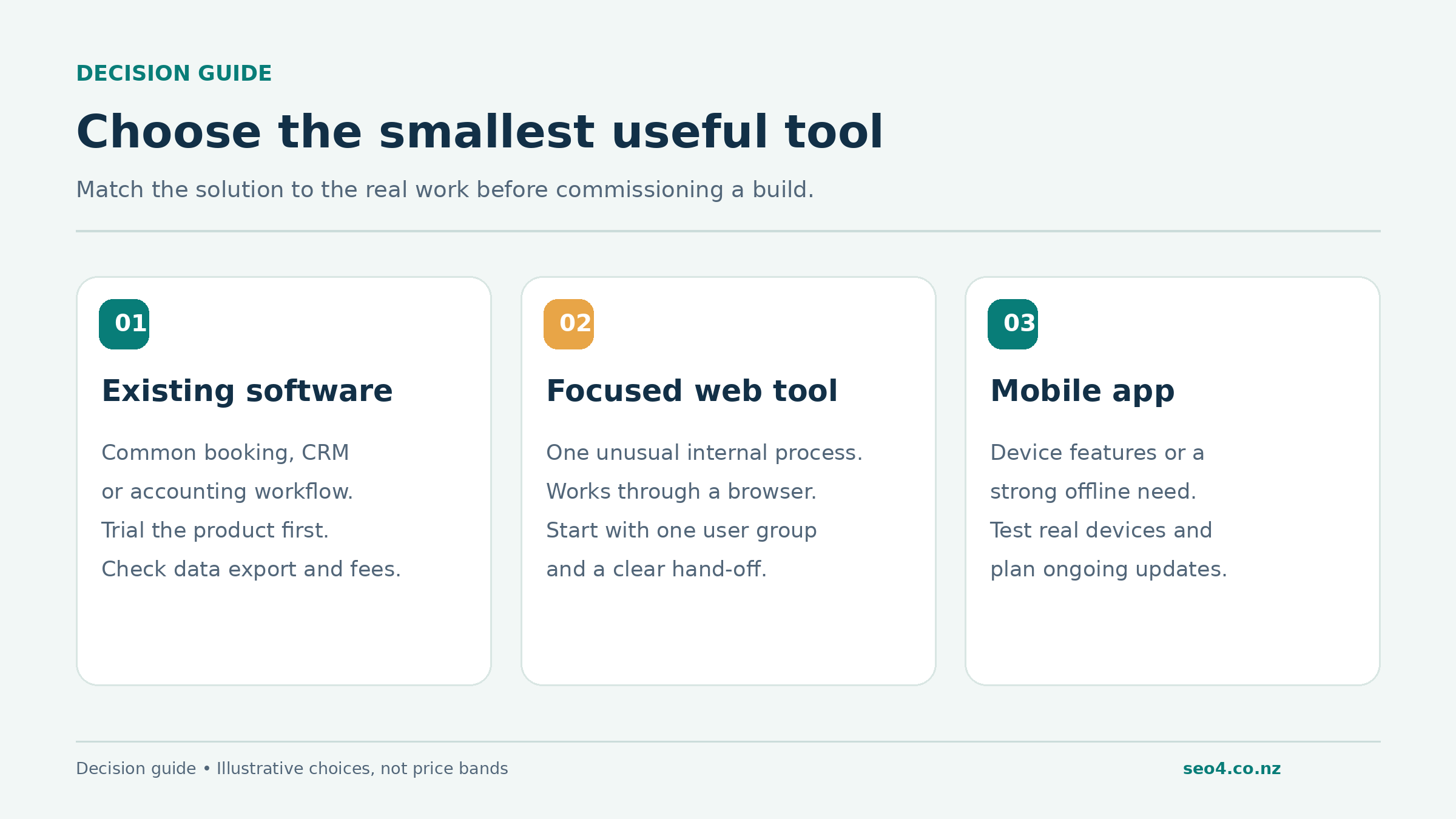
| Starting route | Good fit | Check before paying |
|---|---|---|
| Existing software | Standard bookings, accounting or CRM | Subscription fees, export options and limits |
| Focused web tool | A distinctive internal hand-off or form | Logins, hosting, data access and mobile use |
| Dedicated mobile app | Offline work or device-specific features | Platform testing, release process and maintenance |
Business.govt.nz observes that everyday tools for admin, invoicing, booking and follow-up have become more accessible to small firms. That is a reason to try existing software before commissioning a standard feature from scratch. Where the process really is distinctive, a web app can offer an installable experience in suitable browsers; an app-store release is not automatically required. Frameworks such as Flutter can share a codebase across mobile platforms, although the same codebase does not remove platform testing, backend work or ongoing support. These options can make a first project smaller. They do not prove that every development price has fallen by a particular percentage.
A worked example: stop retyping orders before building a platform
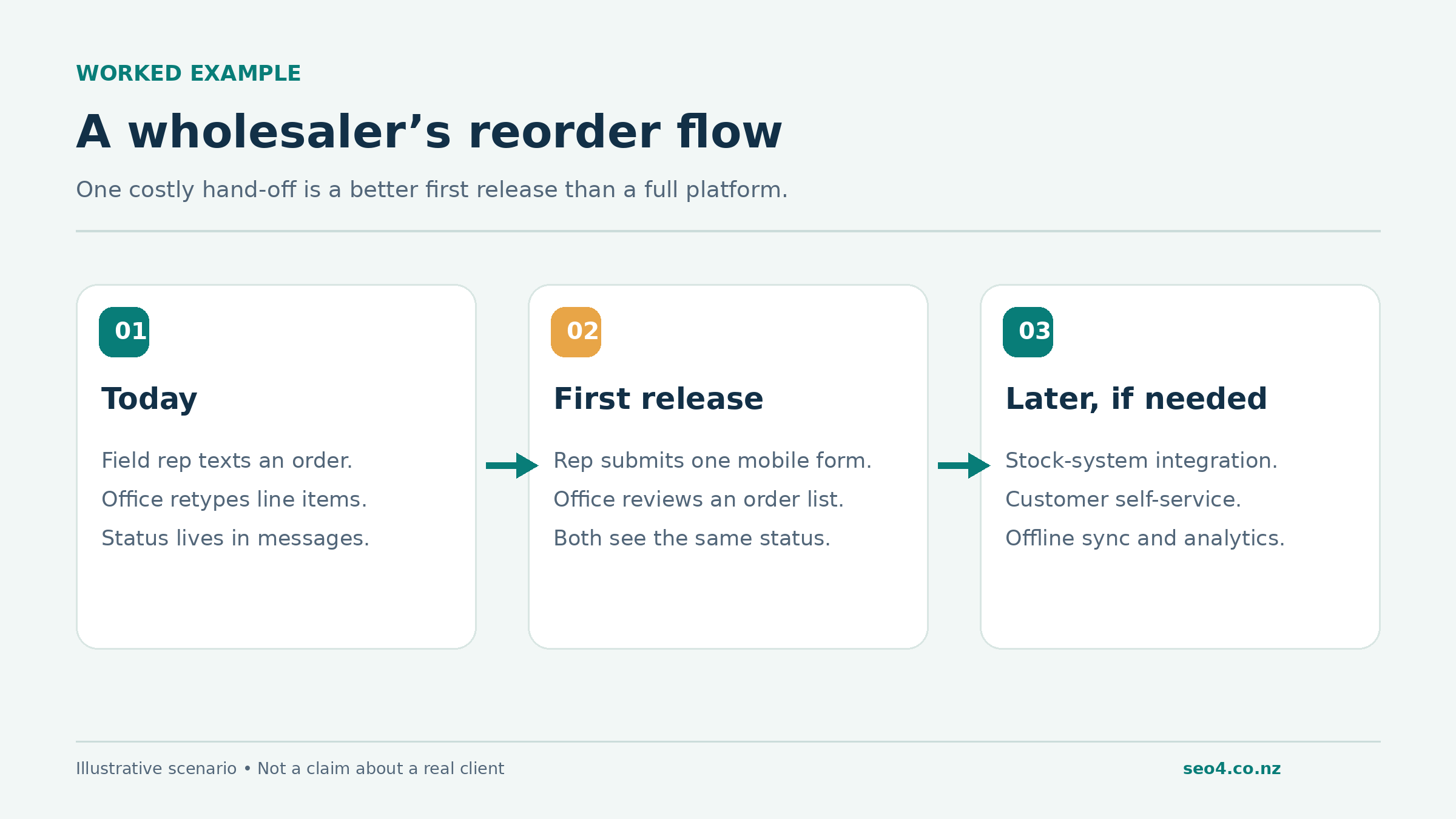
Imagine a small wholesaler whose field reps text orders to the office. Someone then retypes product names and quantities into a spreadsheet and messages the rep about changes. A first release could be a mobile-friendly order form, a shared review list and three statuses: submitted, queried and confirmed. It need not begin with a customer marketplace, live stock integration or a native iPhone and Android launch. This is an illustrative scenario, not a claim about one of our customers.
Measure the pain before requesting quotes. Suppose staff retype 20 orders each week and each takes four minutes. That is 80 minutes a week, or about 69 hours over 52 weeks. At an illustrative internal time value of NZ$40 per hour, the re-entry alone represents about NZ$2,773 a year. These are assumptions for a decision exercise, not observed savings or a promised return. Add the cost of errors if you can document it; then compare the potential benefit with the build, hosting, training and upkeep. This is a more useful way to judge the cost for developing an app than comparing a quote with an imaginary “average app”.
How to keep the cost for developing an app within reach
Write the first release as a task someone can complete: “A rep submits an order and the office can confirm it.” Then agree what “done” means, who enters the data and what happens when an order is wrong. Request a separate estimate for later ideas. In particular, decide whether the first version really needs customer logins, payments, offline synchronisation or an integration with your existing system. Removing a dependency before work begins is usually more effective than asking for every feature to be built cheaply.
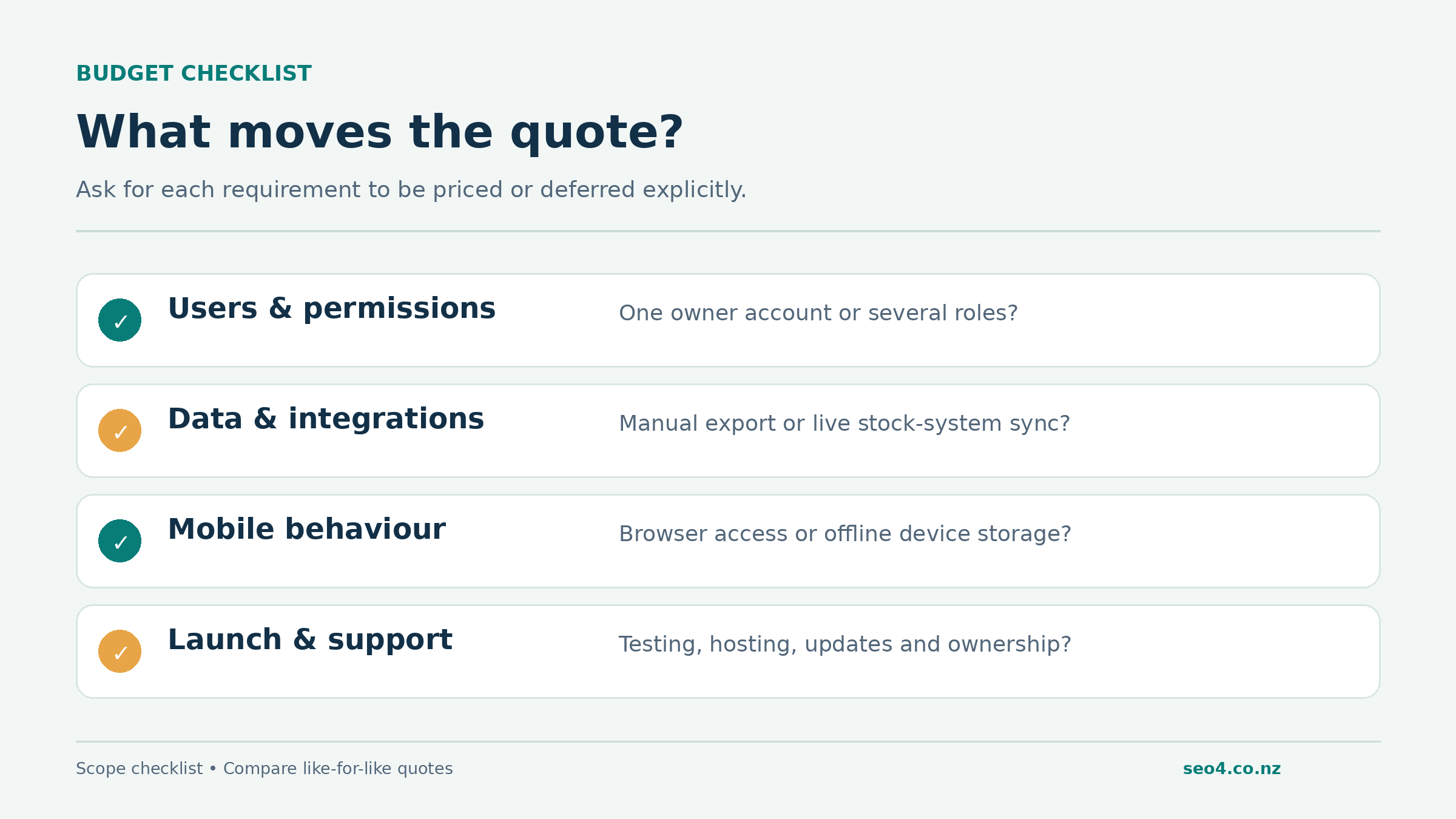
Ask each developer to state the deliverables, exclusions, data ownership, testing devices and post-launch support in writing. If one quote includes a live integration and another assumes manual export, the prices are not directly comparable. For mobile apps, ask who manages developer accounts and future store updates. For a web tool, ask where it is hosted and how you receive an export if you move providers. Those details are part of the cost for developing an app, even if they are not visible in a screen mock-up.
FAQ: cost for developing an app for a small NZ business
Can I build an app for free?
You can test an idea with spreadsheets, free-tier tools or a trial of existing software. Check usage limits, data export, privacy and future subscription charges. “Free to prototype” does not mean “free to operate indefinitely”, and a custom build still requires design, testing and maintenance. Start free where it teaches you which workflow actually matters.
Do I need both iOS and Android at launch?
Only if your first users need both. An internal team with known devices may be able to start with a browser-based tool or one platform. A customer-facing product may have different reach requirements. Confirm the device mix and offline needs with actual users before specifying platforms; that decision changes the cost for developing an app.
What should I send for a realistic estimate?
Send one example of the current task, who performs it, the fields they enter, what happens next, existing software that must connect and the result you want to measure. State your desired timeline and budget range if you have one. We can suggest a smaller first release or explain when an off-the-shelf tool is the better fit. See our custom app development service or email seo4conz@gmail.com with your workflow to discuss a scoped estimate.