
A property owner wants to know what management will cost and who will deal with the next repair. A tenant wants to find a home, book a viewing and get a problem resolved. Waikato Real Estate serves both audiences, alongside its sales business. Its website gives those visitors separate starting points, but some of its strongest promises need more consistent supporting detail.
This Waikato Real Estate review examines the published offer, fees, reputation evidence and public website journeys. The supplied Google screenshot shows 4.8 from 710 reviews. Our research combines website checks and desktop browser interactions dated 2 November 2026. It does not assess individual tenancy disputes, audit client funds or test the management service itself.
Waikato Real Estate at a glance
WRE describes itself as a family-owned business founded in Hamilton in 1985. Its About page names Michelle Pearson, Oliver Pearson and Nick Murray in the leadership team and reports more than 1,200 residential rentals under management. That portfolio figure is company-reported, rather than independently audited here.
| Detail | What we found |
|---|---|
| Office | 757 Te Rapa Road, Te Rapa, Hamilton 3200 |
| Contact | 07 838 9988; hamiltonrentals@wre.co.nz |
| Main offer examined | Residential property management in Hamilton and the wider service area, including Cambridge |
| Google snapshot | 4.8 from 710 reviews; original screenshot capture date unknown |
| Published management fee | 8.25% plus GST |
| Separate letting fee | One week’s rent plus GST when a new tenant is found |
| Operational features advertised | Quarterly inspections, photographic reports, repair coordination and twice-monthly owner payments |
The office phone and address match the supplied Google panel. The team directory gives prospective clients named people and contact routes. Those are useful trust foundations: someone comparing agencies can establish who the business is before requesting an appraisal.
Waikato Real Estate fees: what “all-inclusive” covers
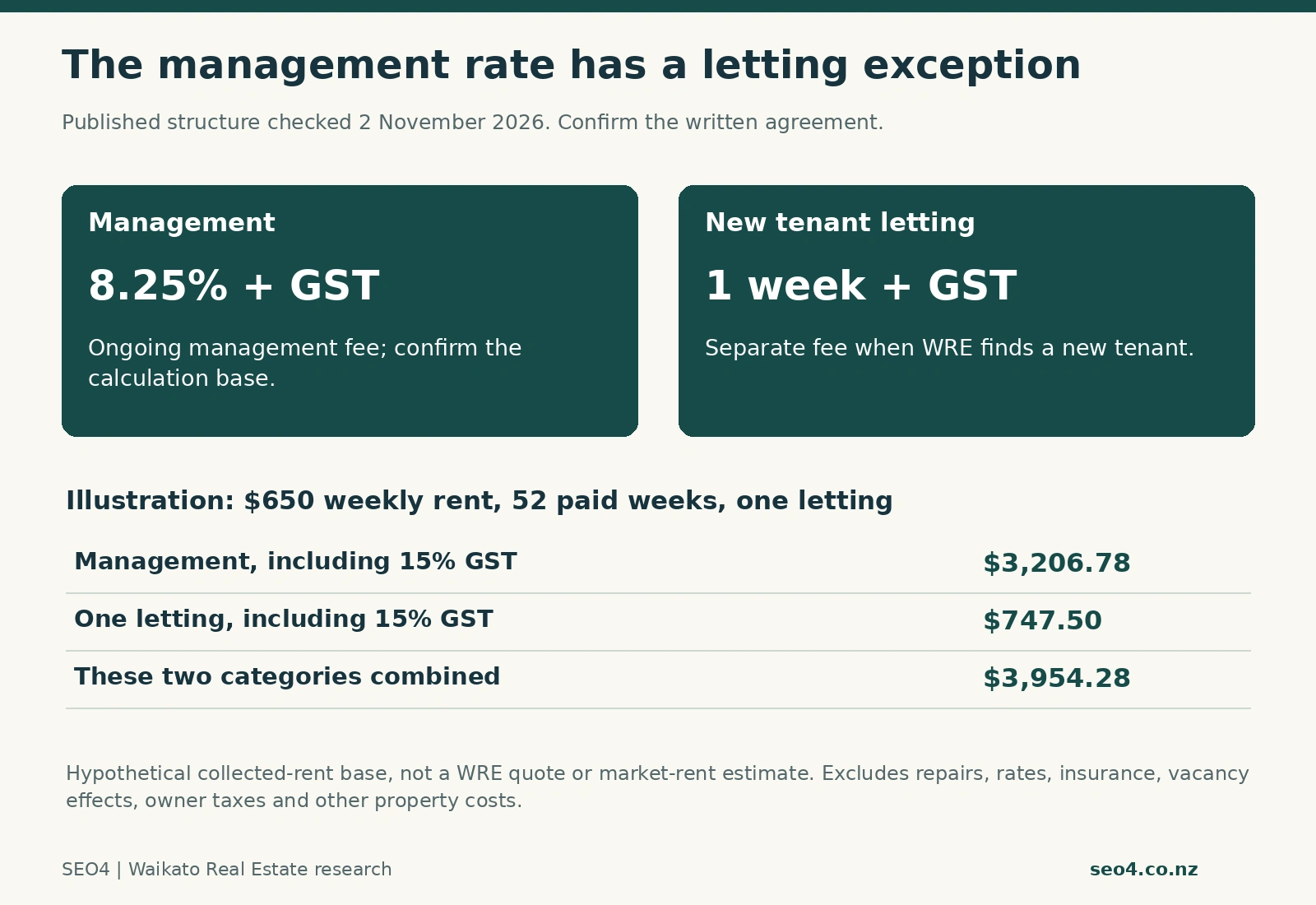
The property management page publishes an 8.25% plus GST management fee. Its live service list includes rent collection, statements, inspections, tenancy documentation and coordination of repairs. The FAQ says the company seeks the owner’s approval for repairs above an agreed spending limit.
The same page also identifies a separate letting fee of one week’s rent plus GST when WRE finds a new tenant. The expanded FAQ says this covers advertising, photographs, viewings, applicant screening and the work involved in establishing the tenancy.
This exception is disclosed. The marketing issue is its prominence: the home page and repeated price blocks describe the service as having no additional costs, while the fuller service page explains the letting charge. Showing that exception beside every headline price would make the offer easier to compare without requiring a reader to reconcile several pages.
“All-inclusive” is a useful phrase until two people discover they have included different things.
A worked fee example
To make the published structure tangible, assume NZ$650 weekly rent, 52 paid weeks, the management percentage applied to that collected rent and one new letting. These are illustrative assumptions, not Hamilton market-rent data or a quote from WRE. Using the current 15% GST rate:
| Item | Calculation | Including GST |
|---|---|---|
| Management | $650 × 52 × 8.25% × 1.15 | $3,206.78 |
| One letting | $650 × 1.15 | $747.50 |
| These two fee categories combined | Management plus one letting | $3,954.28 |
The management rate including GST is equivalent to 9.4875% of the assumed fee base. GST is being added to the management service, not to residential rent. Repairs, insurance, rates, vacancies, owner taxes and other property costs are outside this example. Actual invoices may round by billing period, and the agreement should establish the calculation base and applicable charges.
The letting fee discussed here is a landlord expense. Tenancy Services distinguishes charging a landlord for letting services from the prohibition on charging tenants letting fees. Prospective renters should not mistake WRE’s management pricing for their move-in bill.
Read the reviews by audience
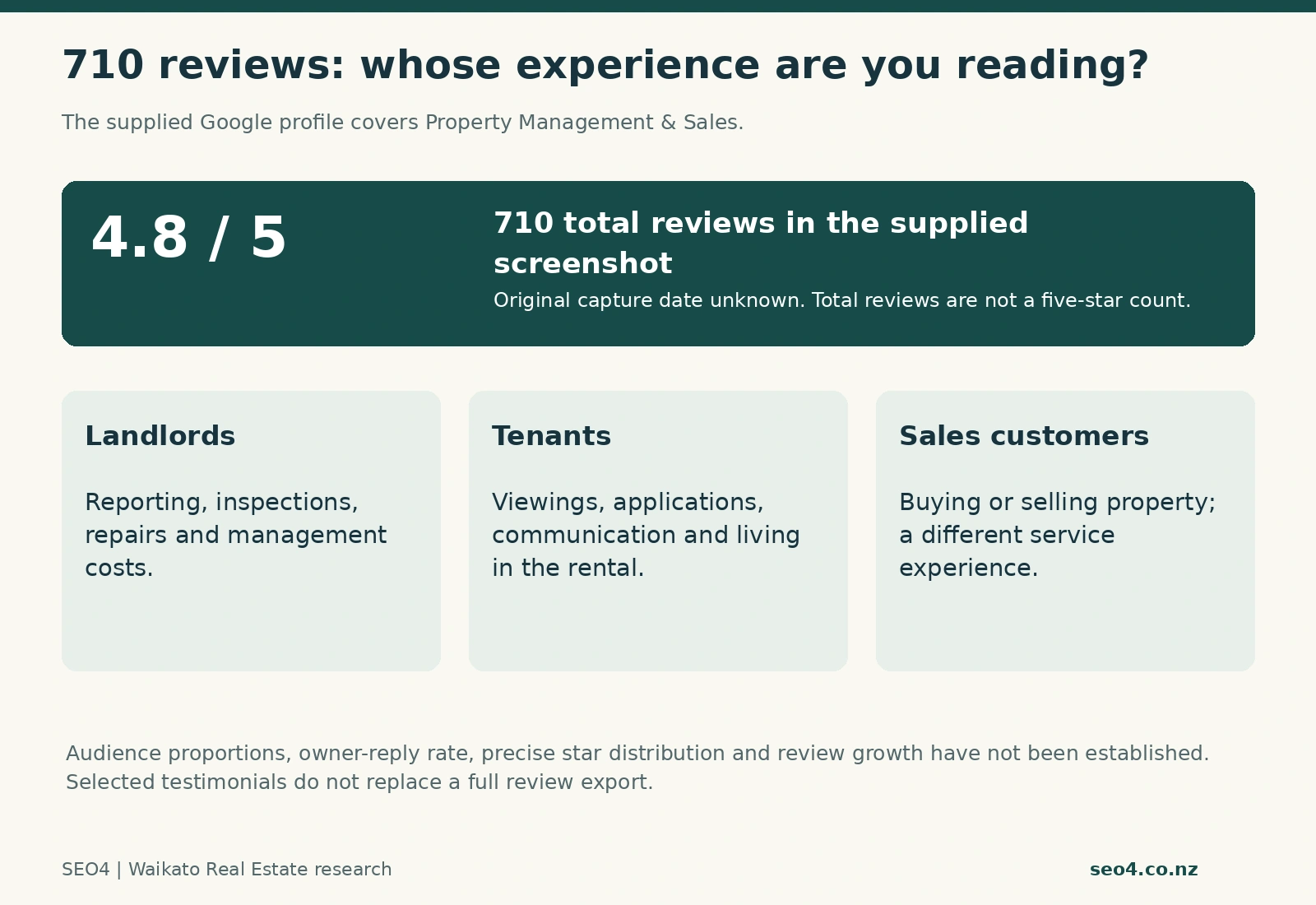
The supplied Google panel covers “Waikato Real Estate – Property Management & Sales”. Its 710 reviews may therefore include owners, tenants and people using sales services. Without the full review record, we cannot establish the proportions or calculate a current owner-reply rate, review-growth trend or exact star distribution.
The website’s selected reviews provide examples of both owner and tenant experiences, with several staff members named. That supports a personal-service narrative, but selected testimonials are not a representative survey. A landlord’s comment about reporting and a tenant’s account of a viewing answer different questions; displaying them under clear audience labels would help each visitor find relevant evidence.
The website also uses several review claims: a 650-plus review label, an older statement about more than 500 five-star reviews and another about more than 700 five-star reviews. Some of these can coexist, but total reviews and five-star reviews are different measures. The supplied screenshot confirms the displayed total and rounded rating, not the number of five-star ratings. WRE could strengthen its evidence by using one dated source and consistent labels throughout the site.
Awards need the same precision. WRE’s awards page describes the PMC Large Office wins in 2023 and 2025, with the 2025 result also reported by Waikato Business News. Its 2020 LPMA award belongs to a different programme. These should retain their organiser, year and category rather than become an undifferentiated claim of winning the same award three times.
The owner’s journey: a clear entrance, then practical questions
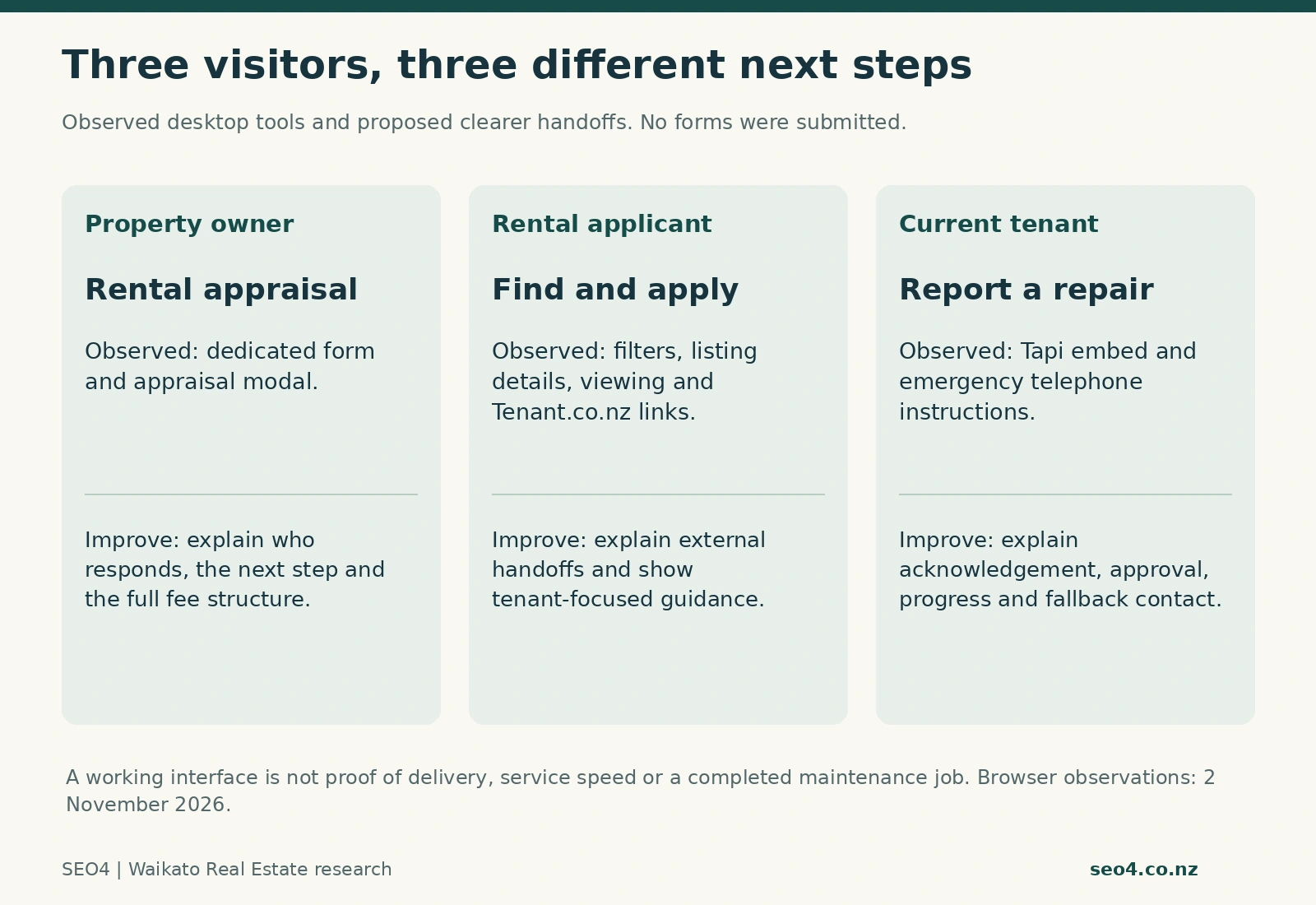
The main navigation separates landlords, tenants and sales. The Book Appraisal button opened a dialogue offering rental or sales appraisal, while the dedicated rental-appraisal page supplied a more focused route. Both presented contact and property details, with a preferred contact method. We inspected the forms without entering personal data or submitting an enquiry.
WRE’s published service has useful specifics. Its FAQ promises quarterly inspections and photographic reports; its service list describes statements and rent payments twice monthly. The property management page also advertises a management-fee refund if a new client is dissatisfied during the first three months, a month-to-month agreement and a 30-day cancellation period. Those are company promises to check against the written agreement, not outcomes we tested.
Before appointing the agency, an owner would benefit from an example report, a clear approval limit for repairs, the contact covering their manager’s absence and the next steps after an appraisal request. A published response-time expectation would help too, provided the business can support it operationally.
The site repeats financial-freedom and stress-reduction messages extensively. A short decision panel near the top could put the fee, letting exception, inspection schedule and service-promise terms together. Whether that improves enquiries should be measured; page length alone does not prove poor conversion.
The tenant’s journey: working tools, with room for clearer guidance
The rental catalogue initially displayed a loading state and then populated its listings. Its filter control revealed town or city, suburb, price, bedroom and bathroom options, plus an Available Now choice. The examined property card led to a detail page with price, availability, a named manager and separate Book Viewing and Apply Now links to Tenant.co.nz.
That is an important distinction for an audit: a basic text download did not show the whole functioning catalogue. It would have been wrong to report that no properties were available merely because the initial HTML lacked the rendered listings.
The user experience could still be more focused. Below the catalogue and on the examined listing, the site returns to a landlord acquisition message about better returns. Someone searching for their next home would be better served there by viewing guidance, application steps and a reliable contact route. A short explanation before an external application handoff would also help visitors understand why the website is changing.
The filter toggle appeared in the accessibility output with an icon-only name. Adding a descriptive accessible label would make that control clearer. This was a specific observation, rather than a complete accessibility or mobile audit.
Repairs and complaints deserve equally clear routes
The repair page distinguishes emergency telephone contact from its online route. In the browser, an embedded Tapi interface displayed a problem-description field, prompts for identifying the item and location, and photo and voice controls. We did not submit a request or test those input methods.
An agency that already has a maintenance platform needs a reliable handoff, not another form for its own sake. Explain what follows a submission: acknowledgement, urgency assessment, owner approval where needed, contractor arrangements and completion. Keep a fallback contact visible if the embedded service does not load. These are proposed improvements, not a claim that WRE’s existing back-office process lacks them.
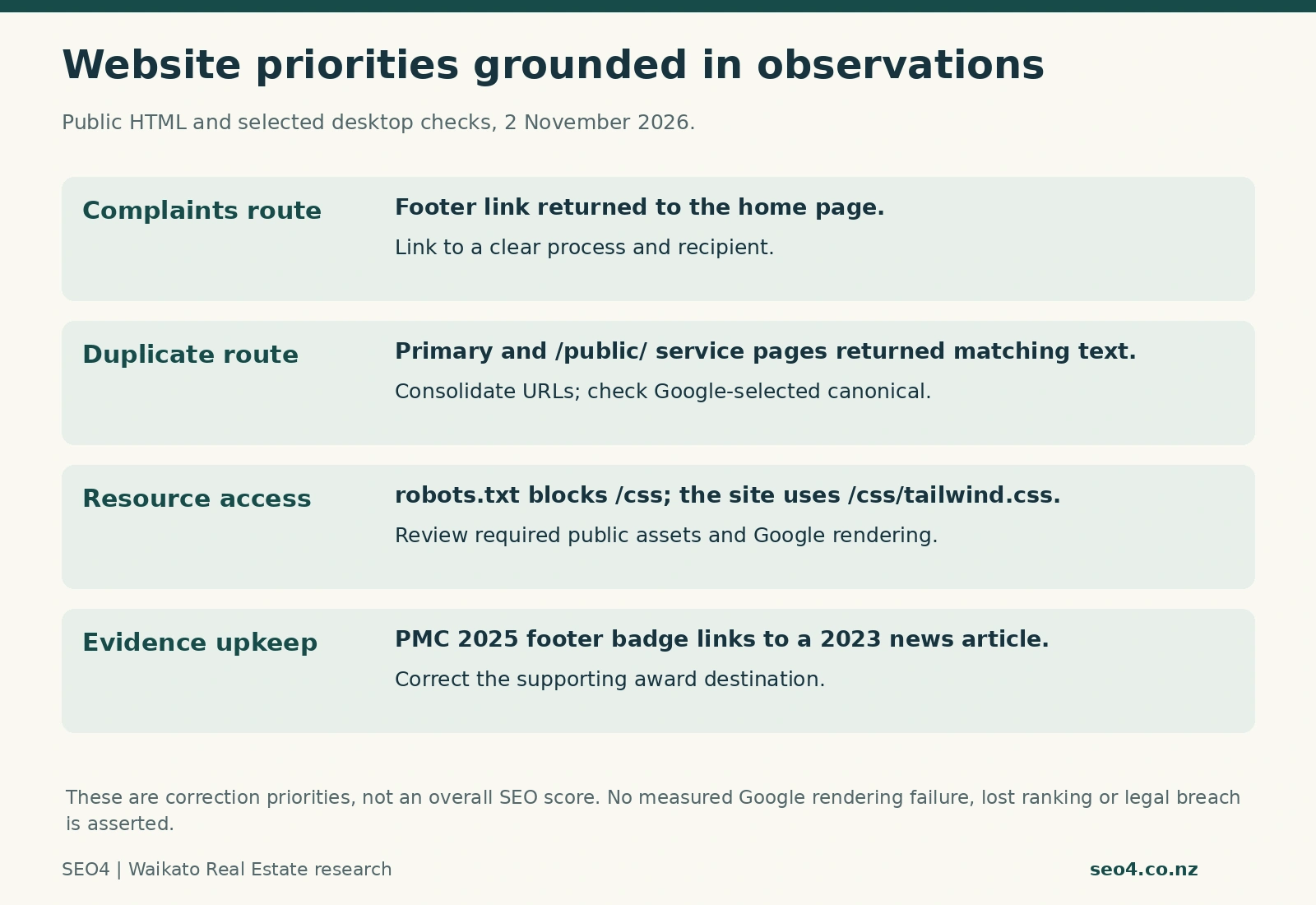
The complaints route was less successful. Clicking the footer’s Complaints Process link returned to the home page; no separate process or visible complaints dialogue opened. That link should lead to a clear recipient and explanation of the next steps. This observation does not establish that the company has no internal procedure, or that it has breached a legal obligation.
A practical SEO audit of wre.co.nz
Our static sample covered 16 content URLs, including an alternative public route, plus robots.txt and the sitemap index. Titles were present across that content sample. Two examined articles also contained BlogPosting structured data with named authors, which is worth retaining.
Consolidate the alternative public address
Both /property-management-hamilton/ and /public/property-management-hamilton/ returned HTTP 200, and their extracted text matched. We found no canonical link in the pair’s HTML or HTTP Link headers, nor on the primary page in the rendered DOM.
Choose the preferred route and use an appropriate redirect or canonical strategy, then align internal links and sitemaps. Google can select a canonical without an explicit tag, so this finding is not proof of a penalty or lost traffic. Search Console is needed to see what Google currently chooses.
Review the robots rules for public assets
The robots file disallows /css, while the home page uses /css/tailwind.css. It also restricts image-related paths. Google’s documentation explains why access to required resources matters for rendering. The next step is a controlled review of the public resources Google needs, keeping private and administrative routes protected.
One technical detail matters: the rule for /js does not prefix-match the active /javascript/react.js bundle. We therefore do not claim that this particular script is blocked by that rule. Nor did we measure the actual Google render or any resulting ranking change.
Finish the smaller consistency tasks
About, Team and Contact lacked an H1 in the retrieved HTML. About and Rental Appraisal lacked meta descriptions. The main property management page already has the service and Hamilton in its title, but its emotional H1 could describe the service more explicitly.
Some staff-role labels and older metadata also need review. The footer’s PMC 2025 badge links to a news article about the 2023 award. Updating these details would make supporting evidence easier to follow. The website has substantial useful content; its awards should not require a small detective agency to establish which year a link describes.
No overall SEO score, PageSpeed result or Core Web Vitals assessment is assigned here.
What WRE could improve first
Start with the letting-fee exception, the complaints destination and the award link. Then resolve the duplicate-route and resource-access questions with the website developer and Search Console. Those actions have clearer purposes than a general redesign brief.
Next, present owner-facing evidence together: a sample inspection report, the maintenance approval process, staff cover and dated performance measures. Label testimonials by audience and keep portfolio, review and award claims in a shared source of current information. An occupancy percentage is more meaningful when its reporting period and calculation method are clear.
For tenants, prioritise listing-to-viewing and listing-to-application continuity, along with maintenance acknowledgement and fallback contact. Measure those journeys separately from landlord acquisition so an application or repair request is not mistaken for a new management lead.
Where contractor software fits
WRE already uses external services for applications and maintenance. SEO4’s Quote & Job Organiser has a narrower role: a painter or handyman can use it to prepare a PDF proposal, schedule accepted work and keep job photos, notes and payment status together on their Android phone.
That does not replace rent accounting, bonds, tenancy management or Tapi. A shared approval workflow or connection to an agency’s systems would require separately scoped development. WRE is not presented as a customer or endorser of the app. The relevant opportunity is to keep a contractor’s agreed scope connected to the repair that was requested.
Common questions about Waikato Real Estate
What does Waikato Real Estate charge for property management?
Its checked service page advertises 8.25% plus GST for management and a separate letting fee of one week’s rent plus GST when it finds a new tenant. Confirm the calculation base, inclusions and applicable terms in the agreement.
What do Waikato Real Estate reviews show?
The supplied Google screenshot shows 4.8 from 710 reviews for a profile covering property management and sales. This review does not claim a complete fresh analysis of every review or the share written by landlords versus tenants.
How often does WRE inspect rentals?
Its published FAQ says quarterly, with digital reports and photographs. This is the advertised schedule; we did not inspect service records.
How do tenants request repairs?
The website has a Book Repair Job page with a Tapi interface and separate emergency-contact instructions. We viewed the interface without submitting a repair request.
Does WRE manage properties in Cambridge?
Yes, its public materials include Cambridge. Confirm coverage and suitability for the particular property when enquiring.
About this review
Checks were made on 2 November 2026 using public HTML, selected desktop interactions, company pages, a supplied Google screenshot and supporting official guidance. We did not submit forms, inspect management records, audit client accounts or test mobile journeys. Company promises, technical observations and editorial recommendations are distinguished throughout. Corrections can be sent through SEO4’s contact page.
Sources and research notes
Checks: 2 November 2026. The supplied Google screenshot has an unknown original capture date. Company promises, public HTML observations and selected desktop checks have different evidential limits. No client records, forms, complaints, applications or maintenance requests were submitted or accessed.
WRE management fees, service terms and FAQ
Regional reporting of PMC 2025 award
Tenancy Services: letting fees
Alternative public service URL